Peptide research continues to expand our understanding of growth hormone modulation, receptor signaling, and metabolic regulation. Among the compounds frequently studied in this area is Ipamorelin, a selective growth hormone secretagogue (GHS) that has drawn attention in laboratory settings for its receptor specificity and controlled biological activity. This article explores Ipamorelin’s structure, mechanism of action, and current research findings.
What Is Ipamorelin?
Ipamorelin is a synthetic pentapeptide belonging to the class of growth hormone secretagogues. It was developed during research into compounds capable of stimulating growth hormone (GH) release without significantly affecting other endocrine pathways. Unlike earlier GHS compounds, Ipamorelin is recognized in research for its high selectivity toward the ghrelin (GHS-R1a) receptor.
Chemical Classification: Growth Hormone Releasing Peptide (GHRP) analog
Structure Type: Pentapeptide
Primary Research Focus: Growth hormone signaling and receptor-specific activation
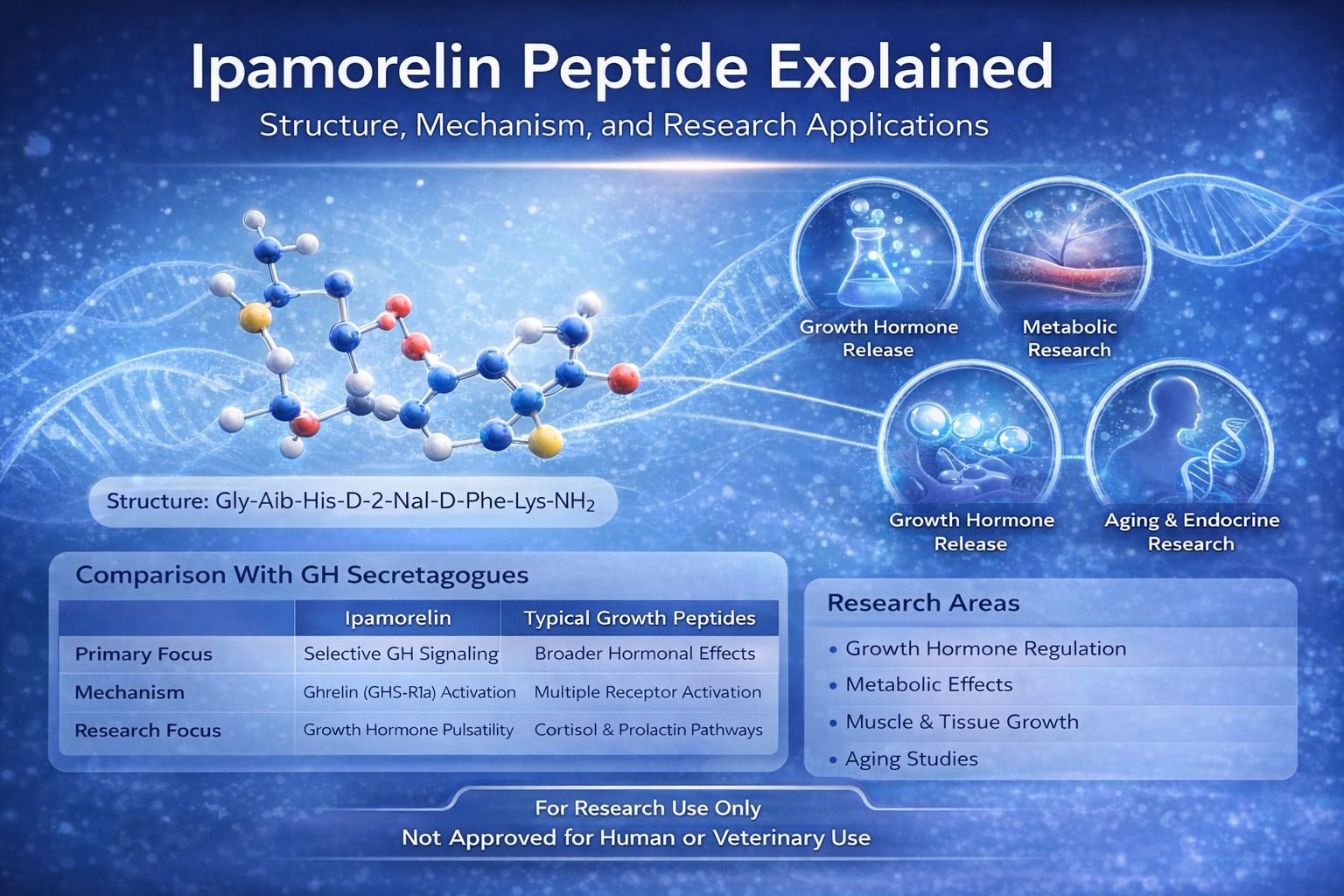
Molecular Structure of Ipamorelin
Ipamorelin is composed of five amino acids arranged to enhance receptor binding while minimizing off-target hormonal effects. Its structure contributes to:
- High receptor selectivity
- Improved stability compared to earlier GHRPs
- Reduced interaction with cortisol and prolactin pathways in controlled studies
The design of Ipamorelin makes it a valuable compound in receptor-binding and endocrine signaling research.
Mechanism of Action
Ipamorelin acts primarily through selective activation of the ghrelin receptor (GHS-R1a) located in the pituitary gland and hypothalamus.
Step-by-Step Mechanism
- Receptor Binding – Ipamorelin binds to GHS-R1a receptors.
- Signal Transduction – Activation triggers intracellular signaling cascades.
- Growth Hormone Release – The pituitary gland releases growth hormone in a pulsatile manner.
- Minimal Secondary Hormone Stimulation – Research suggests limited stimulation of ACTH, cortisol, or prolactin compared to older GHRPs.
This selective pathway is a major reason Ipamorelin is studied as a next-generation GH secretagogue.
Research Areas Involving Ipamorelin
Ipamorelin is not approved as a pharmaceutical treatment but is widely explored in laboratory research related to:
1. Growth Hormone Regulation
Studies examine how selective receptor activation influences GH pulsatility and downstream signaling.
2. Metabolic Research
GH plays a role in metabolism, and Ipamorelin is used in studies observing how controlled GH release affects metabolic pathways.
3. Muscle and Tissue Research
Growth hormone is associated with tissue growth and repair, making Ipamorelin relevant in cellular and regenerative studies.
4. Aging and Endocrine Function Studies
Research models investigating age-related hormonal decline often include GH secretagogues like Ipamorelin.
Comparison With Other Growth Hormone Secretagogues
Feature | Ipamorelin | Older GHRPs |
Receptor Selectivity | High | Moderate |
Cortisol/Prolactin Stimulation | Minimal in studies | Often elevated |
Structure | Pentapeptide | Varies |
Research Focus | Targeted GH release | Broader hormonal stimulation |
Ipamorelin’s selective profile makes it particularly useful in studies requiring controlled GH stimulation without widespread endocrine effects.
Stability and Laboratory Handling
In research environments, peptides like Ipamorelin are handled under strict laboratory protocols.
General research considerations include:
- Storage in low-temperature conditions
- Reconstitution using sterile laboratory-grade solvents
- Protection from repeated freeze-thaw cycles
These practices help preserve peptide integrity for analytical or experimental procedures.
Current Research Status
Ipamorelin remains a research-use-only peptide. It is not approved for medical or therapeutic use. Investigations continue into:
- Long-term receptor signaling effects
- Endocrine response patterns
- Cellular growth pathways
- Comparative studies with other GH secretagogues
Its receptor specificity keeps it relevant in endocrine and peptide science research.
Final Thoughts
Ipamorelin represents a significant development in the study of growth hormone secretagogues due to its targeted mechanism and selective receptor interaction. While not intended for clinical use, it continues to play an important role in laboratory research focused on hormone signaling, metabolism, and tissue biology.
As peptide science advances, compounds like Ipamorelin help researchers better understand how precise receptor modulation can influence complex biological systems.
Disclaimer:
This compound is intended strictly for laboratory research purposes. It is not approved for human or veterinary use, and it is not intended to diagnose, treat, cure, or prevent any disease.