As peptide research expands into longevity science and cellular aging models, one compound that has drawn scientific attention is FOXO4-DRI. Unlike growth hormone–related peptides or metabolic regulators, FOXO4-DRI is studied primarily for its role in cellular senescence and apoptosis signaling pathways.
This article explores FOXO4-DRI’s structure, mechanism of action, and its relevance in experimental senescence research.
Disclaimer: FOXO4-DRI is intended strictly for laboratory research purposes. It is not approved for human consumption, therapeutic use, or medical treatment.
What Is FOXO4-DRI?
FOXO4-DRI is a synthetic peptide engineered to interfere with the interaction between:
- FOXO4 (Forkhead box protein O4)
- p53 (a tumor suppressor protein)
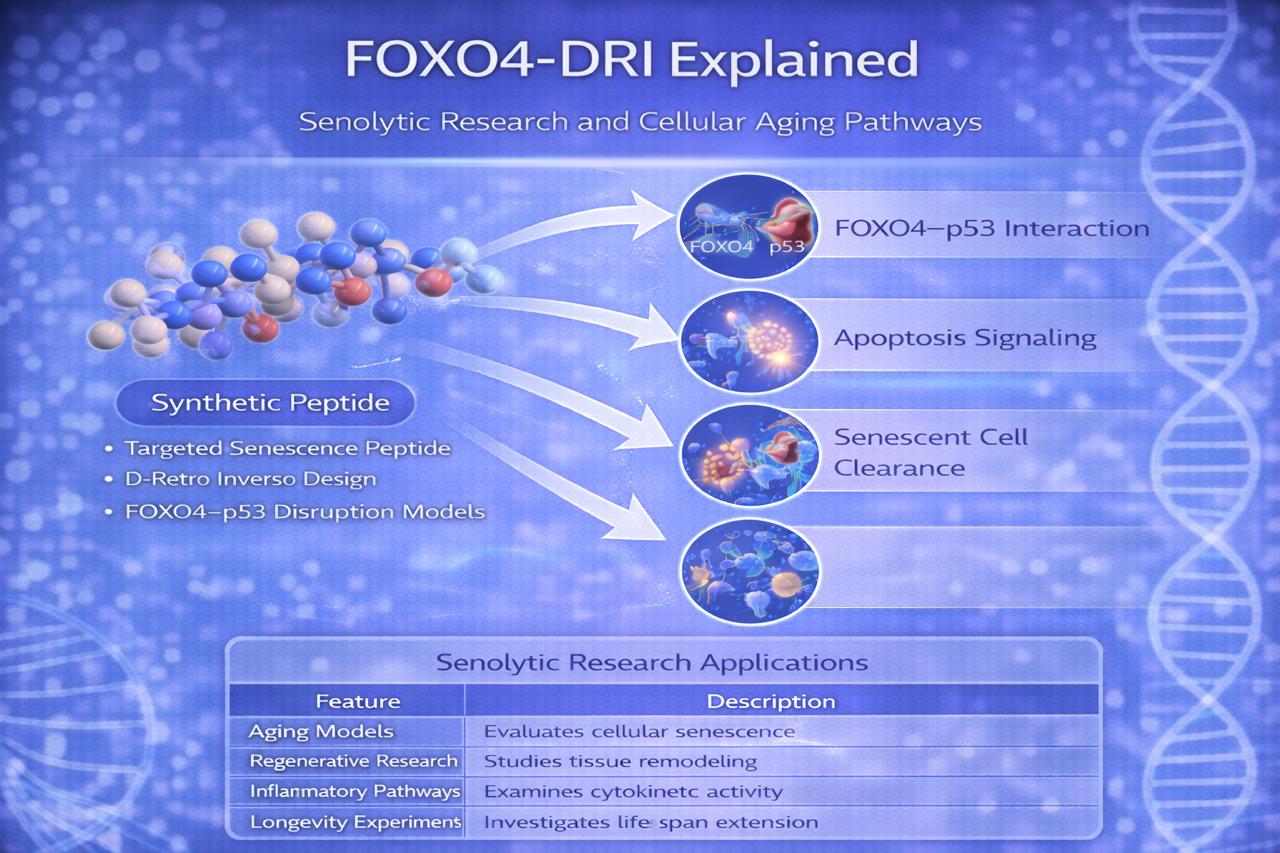
In cellular biology, FOXO4 plays a role in regulating stress resistance, apoptosis, and longevity-related gene expression. Researchers developed FOXO4-DRI (D-Retro Inverso peptide) to selectively disrupt specific protein-protein interactions involved in cellular senescence models.
Understanding Cellular Senescence
Cellular senescence refers to a state where cells:
- Stop dividing
- Resist apoptosis
- Accumulate over time
- Contribute to inflammatory signaling
Senescent cells are widely studied in aging research because they influence tissue function and regenerative capacity.
FOXO4-DRI is investigated as a senolytic research peptide, meaning it is studied for its potential to selectively target senescent cells in experimental models.
Structural Characteristics
FOXO4-DRI is a modified peptide designed using a D-retro inverso configuration, meaning:
- The amino acid sequence is reversed
- D-amino acids are used instead of L-amino acids
- The structure improves stability against enzymatic degradation
This design enhances peptide durability in laboratory conditions while maintaining functional binding properties.
Proposed Mechanism of Action
Research into FOXO4-DRI focuses on its ability to disrupt the FOXO4–p53 interaction within senescent cells.
1. FOXO4–p53 Binding Interference
In senescent cells, FOXO4 can bind to p53, helping prevent apoptosis. FOXO4-DRI is designed to interfere with this binding process.
2. Apoptosis Signaling Activation
By disrupting the FOXO4–p53 interaction, researchers study whether FOXO4-DRI may influence apoptosis signaling pathways specifically in senescent cell models.
3. Senescent Cell Clearance Models
Laboratory investigations explore whether targeted disruption leads to selective removal of senescent cells while minimizing effects on healthy cells.
Areas of Active Research
FOXO4-DRI is typically studied in experimental settings involving:
- Cellular aging models
- Senescence pathway research
- Regenerative biology
- Tissue remodeling studies
- Inflammation signaling pathways
- Longevity-focused laboratory experiments
Its application is primarily confined to controlled preclinical research environments.
FOXO4-DRI vs. Other Longevity Research Peptides
Feature | Epitalon | MOTS-c | |
Primary Focus | Senescent cell targeting | Telomere research | Metabolic regulation |
Mechanism Type | Protein-protein interaction | Telomerase pathway | AMPK activation |
Research Category | Senolytic models | Cellular aging | Mitochondrial signaling |
Structural Type | D-retro inverso peptide | Tetrapeptide | Mitochondrial-derived peptide |
FOXO4-DRI is unique because it targets a specific intracellular protein interaction, rather than a membrane receptor or hormonal pathway.
Laboratory Handling Considerations
In research settings, FOXO4-DRI is typically:
- Supplied in lyophilized form
- Stored at low temperatures
- Reconstituted using sterile research-grade solvents
- Handled with protocols minimizing degradation
Proper handling ensures reproducibility in experimental senescence studies.
Why Senolytic Research Matters
Senescent cells are associated with:
- Tissue aging models
- Chronic inflammatory signaling
- Reduced regenerative capacity
As longevity science evolves, selective senolytic strategies are becoming an important area of laboratory research. FOXO4-DRI represents one of the peptides being studied to better understand these mechanisms.
Final Thoughts
FOXO4-DRI stands at the intersection of peptide engineering and longevity research. Its targeted approach to disrupting intracellular protein interactions makes it a unique tool in senescence and aging studies.
While research remains ongoing, FOXO4-DRI continues to be explored as part of broader investigations into cellular aging, regenerative biology, and stress-response pathways.