Peptide research continues to advance the understanding of targeted molecular interactions, receptor-mediated signaling, and tissue-specific biological processes. Among the experimental compounds investigated in laboratory settings is Adipotide, a synthetic peptide designed to study selective peptide targeting and cellular communication mechanisms.
Its engineered structure and targeted research applications have made Adipotide an important subject for scientists exploring peptide design, receptor specificity, and molecular signaling pathways.
What is Adipotide?
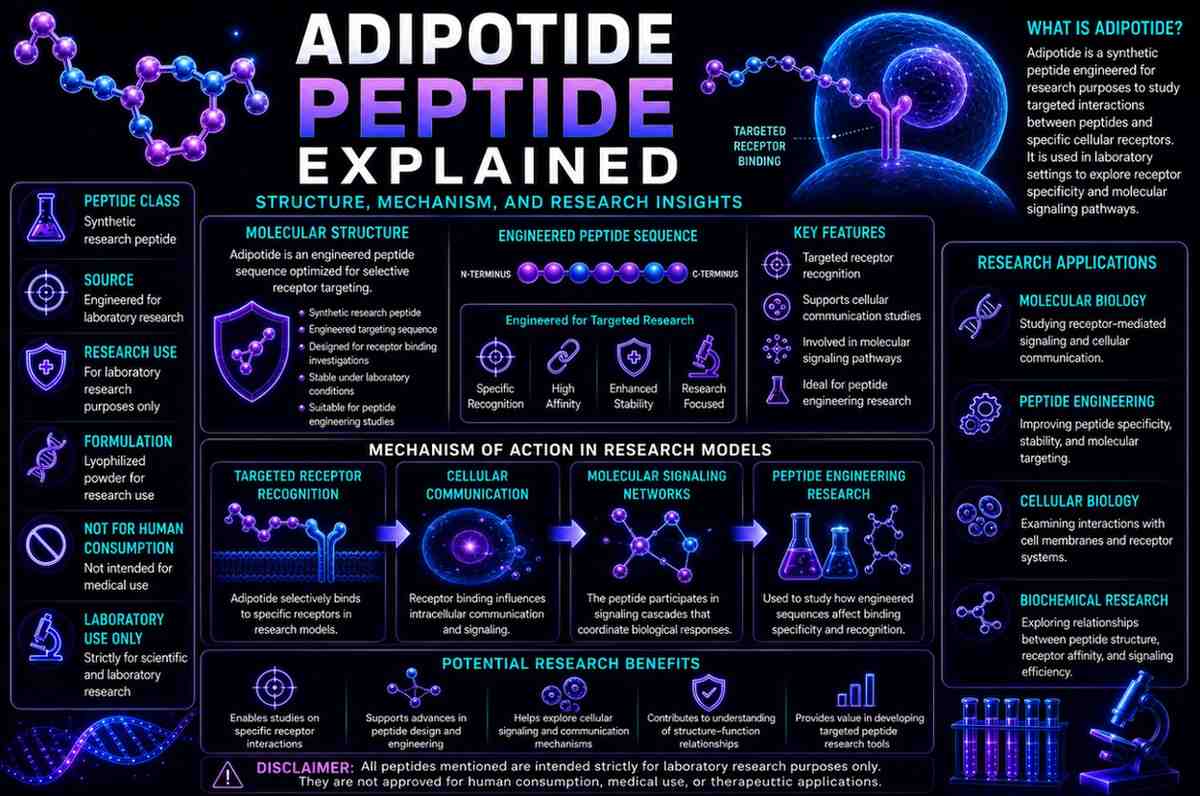
Adipotide is a synthetic research peptide engineered to investigate targeted interactions between peptides and specific cellular receptors. Unlike naturally occurring peptides, Adipotide was designed through peptide engineering to study selective binding and tissue-targeting mechanisms in controlled laboratory models.
Researchers use Adipotide to better understand how engineered peptides can recognize specific biological targets and influence cellular signaling networks.
Adipotide is a laboratory-engineered peptide with a sequence optimized for receptor-targeting research.
Its molecular architecture provides researchers with an opportunity to investigate structure-function relationships and peptide specificity.
Mechanism of Action in Research Models
Laboratory investigations suggest that Adipotide interacts with receptor-mediated signaling pathways involved in targeted cellular communication.
Researchers investigate how Adipotide selectively recognizes specific receptor populations in experimental models.
Studies explore how receptor binding influences intracellular signaling and coordinated biological responses.
Scientists examine the peptide’s participation in signaling cascades associated with peptide-receptor interactions.
Adipotide is also used to investigate how engineered peptide sequences influence binding specificity and molecular recognition.
Adipotide is investigated across several areas of peptide science.
Researchers study receptor-mediated peptide signaling and cellular communication.
Scientists investigate methods for improving peptide specificity, stability, and molecular targeting.
Laboratory models examine peptide interactions with biological membranes and receptor systems.
Research explores relationships between peptide structure, receptor affinity, and signaling efficiency.
Importance of Targeted Research Peptides
Engineered peptides provide valuable tools for understanding how molecular structure influences receptor recognition and biological communication. Studies involving Adipotidecontribute to advances in peptide engineering, molecular targeting, and receptor biology.
As researchers continue to develop highly specific peptide molecules, compounds like Adipotide offer valuable insight into the future of precision peptide design.
Adipotide represents an innovative area of peptide research focused on receptor specificity and molecular targeting. Its engineered design and laboratory applications continue to support investigations into peptide-mediated signaling and biological communication.
As peptide science evolves, Adipotide remains a valuable research tool for exploring targeted molecular interactions and peptide engineering strategies.
All peptides mentioned are intended strictly for laboratory research purposes only. They are not approved for human consumption, medical use, or therapeutic applications.