Peptide research continues to reveal the complexity of cellular communication, neuroendocrine signaling, and receptor-mediated biological processes. Among the naturally occurring neuropeptides investigated in laboratory settings is Cortistatin (CST), a cyclic peptide studied for its interactions with somatostatin receptors and its role in molecular signaling networks.
Due to its structural similarity to somatostatin and its unique biological characteristics, Cortistatin has become an important subject in neuroscience, molecular biology, and peptide receptor research.
What is Cortistatin?
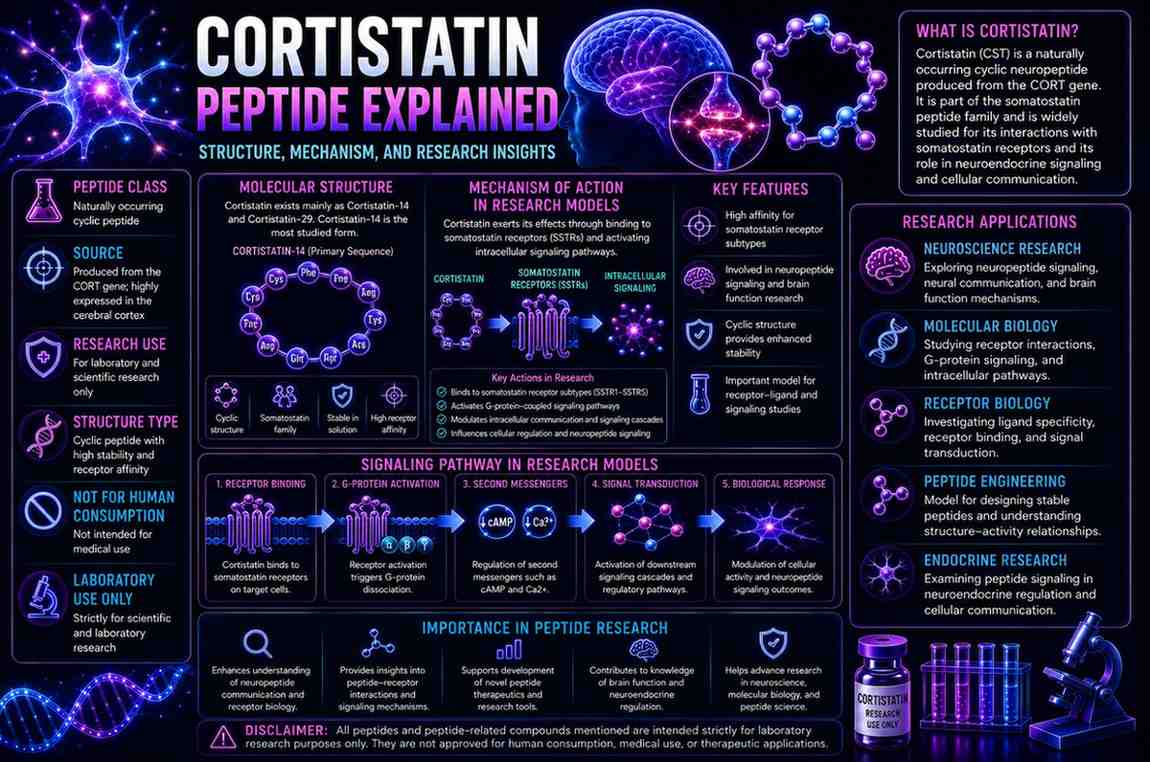
Cortistatin is a naturally occurring cyclic neuropeptide first identified in the cerebral cortex. It is produced from the CORT gene and belongs to the somatostatin peptide family.
Researchers investigate Cortistatin to better understand peptide-mediated communication, receptor specificity, and intracellular signaling mechanisms. Because of its structural relationship with somatostatin, Cortistatin serves as an excellent model for studying peptide–receptor interactions.
Cortistatin exists primarily as Cortistatin-14 and Cortistatin-29, with Cortistatin-14 being the most extensively investigated in laboratory research.
Its cyclic structure contributes to its stability and receptor-binding characteristics.
Mechanism of Action in Research Models
Laboratory investigations continue to examine several molecular mechanisms associated with Cortistatin.
Researchers study how Cortistatin interacts with somatostatin receptor subtypes (SSTRs) to initiate receptor-mediated signaling.
Experimental models investigate the peptide’s role in coordinating intracellular communication through G-protein-coupled receptor pathways.
Scientists explore downstream signaling cascades activated following receptor engagement, including pathways involved in cellular regulation.
Structure–Activity Relationship Studies
Research continues to examine how the cyclic structure of Cortistatin influences receptor selectivity, binding affinity, and signaling efficiency.
Cortistatin is investigated across numerous areas of peptide science.
Scientists study Cortistatin to understand neuropeptide signaling, receptor interactions, and communication between neural cells.
Researchers investigate peptide-mediated signaling pathways and receptor activation mechanisms.
Laboratory studies focus on ligand specificity, receptor binding, and intracellular signaling events.
Cortistatin serves as a valuable model for investigating how peptide structure influences biological activity and receptor recognition.
Importance of Cyclic Neuropeptides
Cyclic neuropeptides provide researchers with valuable insight into how peptide structure affects receptor interactions and biological signaling. By studying Cortistatin, scientists gain a better understanding of peptide evolution, molecular recognition, and receptor-mediated communication.
Research involving Cortistatin also contributes to broader advances in neurobiology and peptide engineering.
Cortistatin remains an important subject in peptide research because of its unique cyclic structure, receptor specificity, and role in neuropeptide signaling studies. Ongoing laboratory investigations continue to expand scientific understanding of peptide–receptor interactions and intracellular communication.
As peptide science progresses, Cortistatin continues to serve as a valuable research model for exploring molecular signaling and receptor biology.
All peptides and peptide-related compounds mentioned are intended strictly for laboratory research purposes only. They are not approved for human consumption, medical use, or therapeutic applications.