Peptide research continues to reveal how small signaling molecules participate in complex communication networks throughout the body. Among the naturally occurring peptides investigated in modern laboratory research is Nesfatin-1, a peptide derived from nucleobindin-2 (NUCB2) that has attracted scientific interest because of its interactions with neuroendocrine signaling pathways and cellular communication systems.
Its distinctive origin, distribution, and molecular activity make Nesfatin-1 an interesting subject for neuroscience, endocrinology, molecular biology, and peptide research.
What is Nesfatin-1?
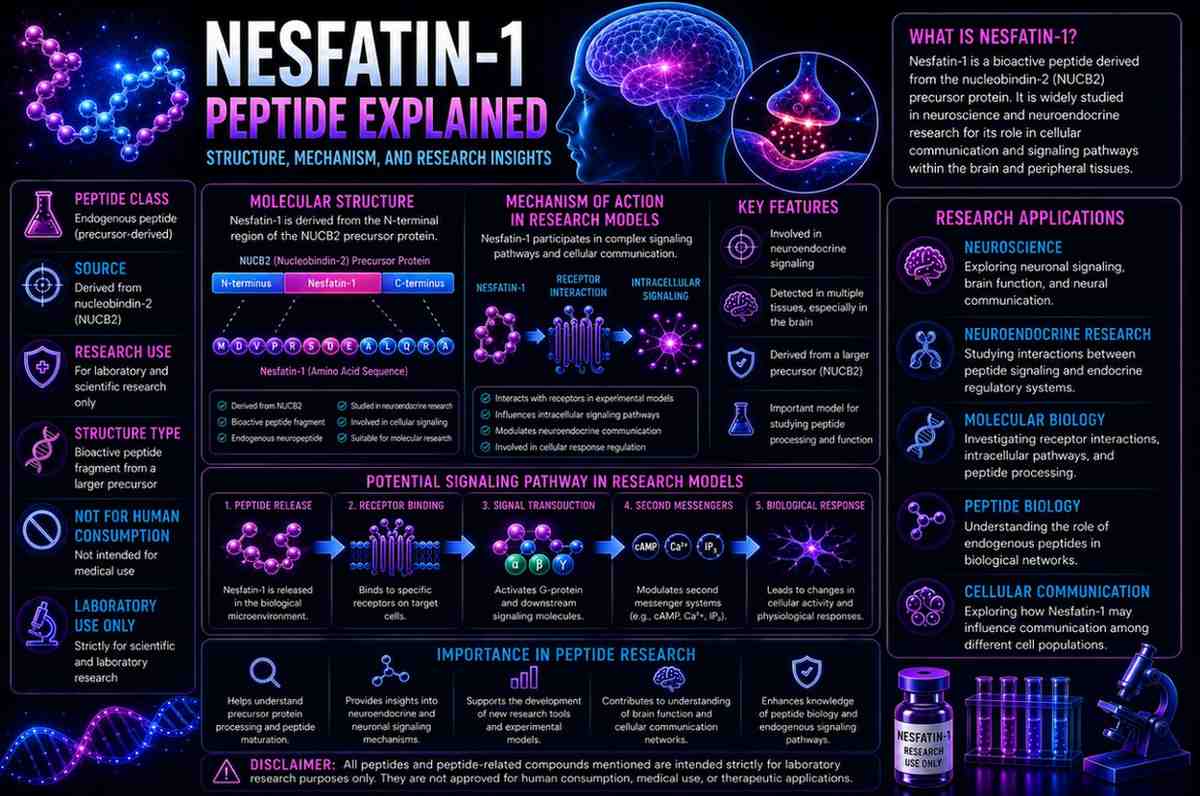
Nesfatin-1 is a bioactive peptide derived from the larger precursor protein nucleobindin-2 (NUCB2).
Researchers investigate Nesfatin-1 to understand how peptide signaling contributes to communication between neural, endocrine, and metabolic systems. The peptide has been detected in several tissues and is particularly studied in experimental models involving the central nervous system and neuroendocrine signaling.
Because Nesfatin-1 originates from a larger precursor protein, researchers can also use it to investigate peptide processing and precursor-derived signaling molecules.
Molecular Structure of Nesfatin-1
Nesfatin-1 is derived from the N-terminal region of the NUCB2 precursor protein.
Its precursor-derived structure provides researchers with an opportunity to study how larger proteins can generate biologically active peptide fragments.
Mechanism of Action in Research Models
The precise molecular mechanisms of Nesfatin-1 continue to be investigated. Research has focused on several potential signaling pathways and cellular interactions.
Researchers investigate how Nesfatin-1 participates in communication between neural and endocrine systems.
Receptor and Signaling Studies
Experimental models examine potential receptor-mediated interactions and downstream intracellular signaling associated with the peptide.
Scientists study how Nesfatin-1 may influence communication between different cell populations within experimental biological systems.
Because Nesfatin-1 originates from NUCB2, researchers also investigate how enzymatic processing of precursor proteins generates biologically active peptide fragments.
Nesfatin-1 is investigated across several areas of scientific research.
Researchers study Nesfatin-1 in relation to neuronal signaling and communication within the central nervous system.
Laboratory models examine interactions between peptide signaling and endocrine regulatory pathways.
Scientists investigate peptide processing, precursor proteins, receptor interactions, and intracellular signaling.
Nesfatin-1 provides a useful model for studying how endogenous peptide fragments function within complex biological networks.
Importance of Precursor-Derived Peptides
Many biologically active peptides originate from larger precursor proteins. Studying these molecules helps researchers understand how enzymatic processing can generate signaling peptides with distinct biological properties.
Nesfatin-1 provides an interesting example of this process and contributes to broader research into peptide maturation, molecular communication, and neuroendocrine biology.
Understanding precursor-derived peptides may also help researchers identify new relationships between protein structure and biological signaling.
Nesfatin-1 represents an interesting area of modern peptide research because of its origin from NUCB2 and its involvement in experimental studies of neuroendocrine and cellular signaling.
Continued laboratory research may provide greater insight into peptide processing, molecular communication, and the complex signaling networks involving naturally occurring peptide fragments.
As peptide science continues to expand, Nesfatin-1 remains a useful research model for investigating the relationship between precursor proteins, bioactive peptides, and cellular signaling.
All peptides and peptide-related compounds mentioned are intended strictly for laboratory research purposes only. They are not approved for human consumption, medical use, or therapeutic applications.