Peptide research continues to explore how short molecular sequences can participate in cellular communication, neurobiological signaling, and gene-regulation processes. Among the experimental peptides investigated in these areas is Pinealon, also known as EDR, a synthetic tripeptide composed of glutamic acid, aspartic acid, and arginine.
Unlike many peptide research compounds that primarily interact with cell-surface receptors, Pinealon has attracted scientific interest because researchers have investigated its potential interactions with intracellular and nuclear components.
What is Pinealon?
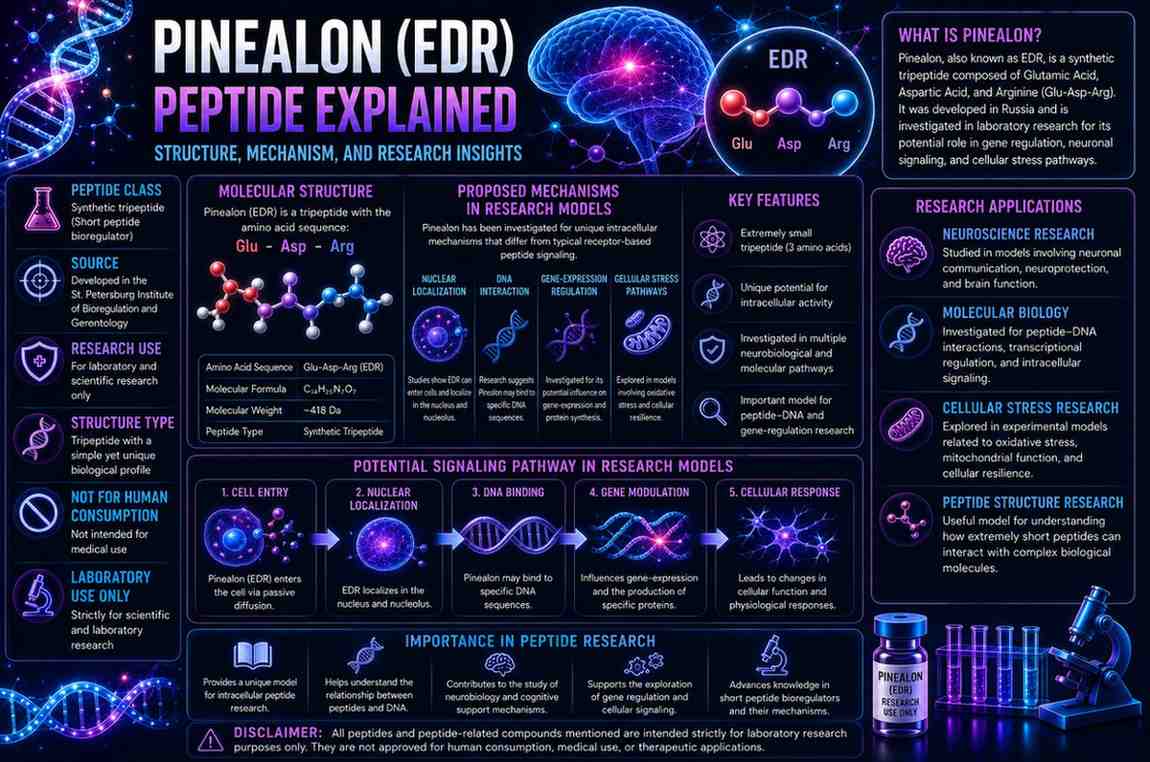
Pinealon (EDR) is a synthetic tripeptide with the amino-acid sequence Glu-Asp-Arg.
It originated from the short-peptide bioregulator research program associated with the St. Petersburg Institute of Bioregulation and Gerontology. Laboratory investigations have explored Pinealon in models involving neuronal signaling, cellular stress, gene-expression mechanisms, and molecular regulation.
Importantly, many proposed mechanisms remain experimental hypotheses rather than established clinical mechanisms.
Molecular Structure of Pinealon
Pinealon is one of the simplest research peptides, consisting of only three amino acids.
Its exceptionally small molecular size makes Pinealon an interesting model for studying how short peptides interact with larger biological molecules.
Proposed Mechanisms in Research Models
Research into Pinealon has investigated mechanisms that differ from conventional peptide-receptor signaling.
Experimental studies have reported that labeled EDR peptide can be detected within cellular compartments, including the nucleus and nucleolus, providing a basis for investigating possible intracellular activity.
Researchers have explored whether Pinealon can interact with DNA and specific nucleotide sequences. These findings form part of a proposed mechanism rather than an established therapeutic pathway.
Experimental models have investigated whether Pinealon may influence gene-expression and protein-synthesis processes associated with cellular regulation.
Preclinical research has also examined Pinealon in models involving oxidative stress, neuronal responses, and cellular resilience.
Pinealon is investigated across several areas of laboratory science.
Researchers study EDR in experimental models involving neuronal communication and neurobiological regulation.
Laboratory studies investigate peptide–DNA interactions, gene-expression mechanisms, and intracellular molecular signaling.
Experimental models examine how short peptides may interact with pathways associated with oxidative and cellular stress.
Because Pinealon contains only three amino acids, it provides a useful model for investigating how extremely short peptide sequences can interact with complex biological molecules.
Pinealon and Peptide–DNA Research
One of the most distinctive areas of Pinealon research involves its proposed interaction with DNA.
Researchers have used biochemical experiments, imaging techniques, and computational modeling to investigate whether EDR can enter cellular compartments and interact with nucleic acids.
These studies are scientifically interesting because they explore a mechanism that differs from the classic model of extracellular peptide binding to a membrane receptor.
However, proposed molecular mechanisms should be distinguished from clinically established effects. Further independent research is necessary to determine how these observations translate across different experimental systems.
Pinealon remains an experimental research peptide, and the available evidence is still developing.
Published investigations include cellular experiments, animal models, mechanistic studies, and limited human research reports. However, the evidence base is substantially smaller than that of many established pharmaceutical compounds, and independent replication remains an important area for future research.
This makes Pinealon particularly interesting as a research subject, while also highlighting the importance of interpreting experimental findings cautiously.
Why Researchers Study Pinealon
Pinealon provides an unusual model for investigating the biological activity of extremely short peptides.
Its small structure allows researchers to explore questions involving:
These research areas contribute to the broader scientific understanding of how small peptides can interact with complex biological systems.
Pinealon represents an intriguing area of peptide research because of its exceptionally small structure and the proposed intracellular mechanisms investigated in experimental models.
Research into the EDR tripeptide continues to explore peptide–DNA interactions, molecular signaling, neuronal biology, and cellular regulation. At the same time, the limited and developing evidence base means that findings should remain within their appropriate laboratory and research context.
As peptide science continues to evolve, Pinealon offers researchers a valuable model for investigating how very short peptide sequences can interact with complex molecular systems.
All peptides and peptide-related compounds mentioned are intended strictly for laboratory research purposes only. They are not approved for human consumption, medical use, or therapeutic applications. Experimental findings should not be interpreted as evidence of clinical efficacy or safety.