Peptide research continues to advance our understanding of neurobiology, cellular signaling, and protein-mediated communication. Among the compounds investigated in neuroscience research is Cerebrolysin, a peptide-based preparation studied for its interaction with neuronal signaling pathways and cellular communication networks.
Its complex composition and broad research applications have made Cerebrolysin an important subject in laboratory investigations involving neurobiology, molecular regulation, and peptide-mediated signaling.
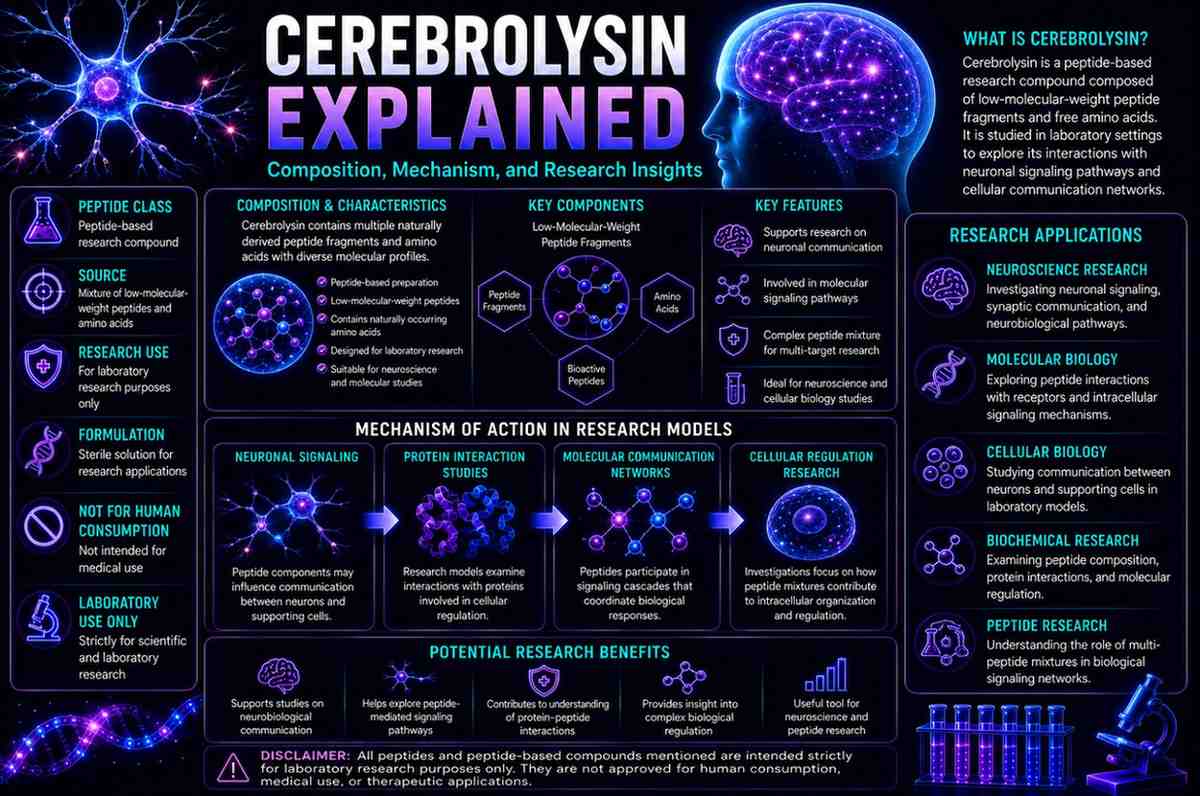
What is Cerebrolysin?
Cerebrolysin is a peptide-based research compound consisting of a mixture of low-molecular-weight peptides and free amino acids. Researchers investigate its biological activity to better understand peptide-mediated communication within experimental neurological models.
Because it contains multiple bioactive peptide fragments, Cerebrolysin is frequently used to study complex signaling interactions between neurons and surrounding cellular environments.
Composition and Molecular Characteristics
Unlike single-sequence synthetic peptides, Cerebrolysin contains numerous naturally derived peptide fragments.
Its diverse peptide composition allows researchers to explore multiple signaling pathways simultaneously.
Mechanism of Action in Research Models
Laboratory studies suggest that Cerebrolysin interacts with several molecular communication systems involved in neuronal biology.
Researchers investigate how peptide components participate in communication between neural cells and intracellular signaling pathways.
Experimental models examine interactions between peptide fragments and proteins involved in cellular regulation.
Molecular Communication Networks
Scientists explore how peptide mixtures influence signaling cascades responsible for coordinating biological responses.
Ongoing laboratory investigations examine Cerebrolysin’s role in peptide-mediated communication and intracellular organization.
Cerebrolysin continues to be studied across multiple scientific disciplines.
Scientists investigate peptide-mediated signaling involved in neuronal communication and biological regulation.
Researchers examine interactions between peptide fragments, receptors, and intracellular signaling pathways.
Experimental studies explore communication between neurons and supporting cellular environments.
Laboratory models investigate relationships between peptide composition, protein interactions, and molecular signaling mechanisms.
Importance of Multi-Peptide Research
Studying peptide mixtures provides valuable insight into how multiple signaling molecules coordinate biological communication. Research involving Cerebrolysin contributes to a broader understanding of peptide interactions, receptor activity, and molecular regulation within complex biological systems.
As peptide science continues to evolve, multi-component preparations offer unique opportunities to investigate integrated signaling mechanisms.
Cerebrolysin represents an important area of peptide research because of its diverse peptide composition and relevance to neuroscience studies. Ongoing laboratory investigations continue to improve scientific understanding of peptide-mediated communication, molecular signaling, and biological regulation.
Its complex profile makes it a valuable research tool for exploring interactions between multiple peptide fragments and cellular signaling networks.
All peptides and peptide-based compounds mentioned are intended strictly for laboratory research purposes only. They are not approved for human consumption, medical use, or therapeutic applications.