Peptide research continues to advance our understanding of endocrine signaling and growth hormone regulation. Among the compounds studied in laboratory settings, CJC-1295 has gained attention for its extended activity and interaction with growth hormone pathways. This synthetic peptide is widely examined in research environments for its role in stimulating endogenous growth hormone release.
This article explores CJC-1295’s structure, mechanism of action, and current research interest.
What Is CJC-1295?
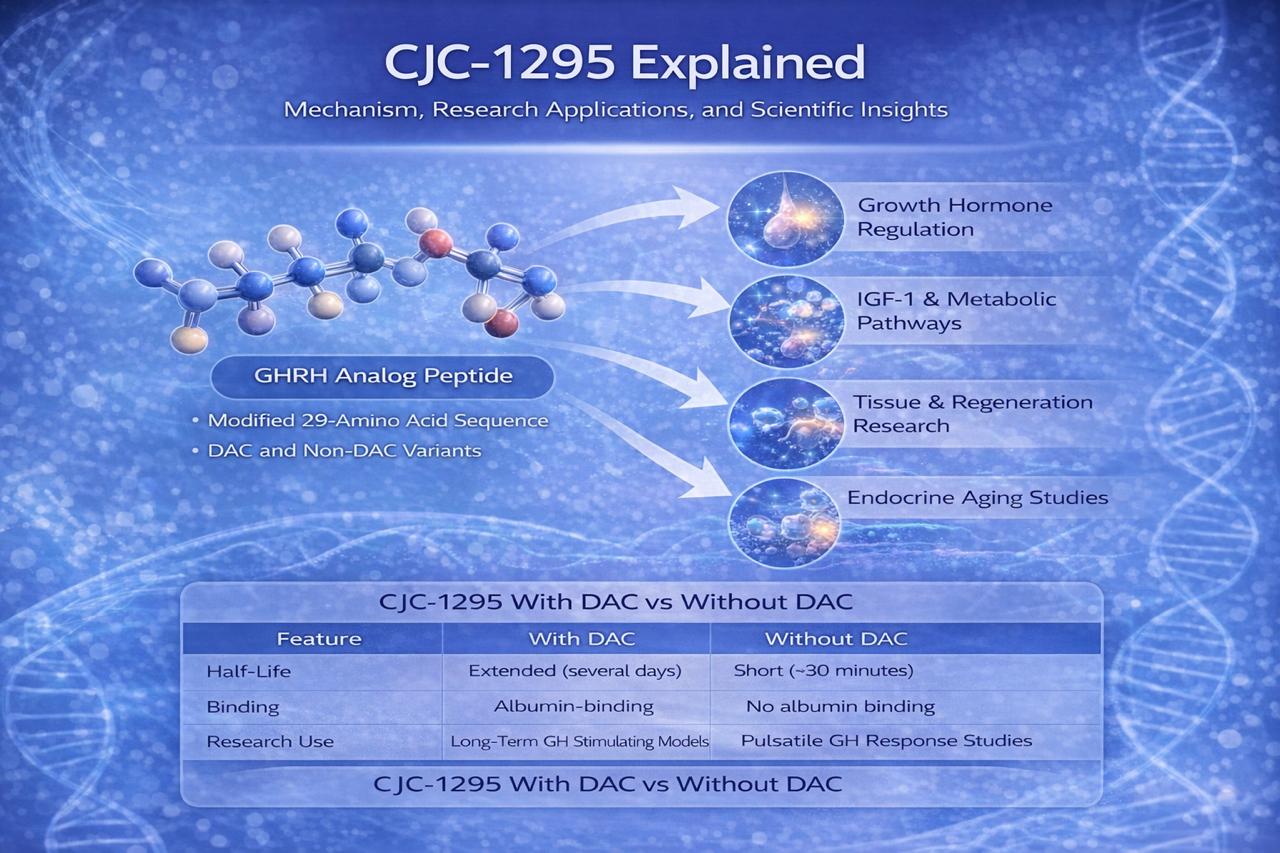
CJC-1295 is a synthetic analog of growth hormone-releasing hormone (GHRH). It was designed to enhance stability and prolong biological activity compared to natural GHRH.
There are two common research forms:
- CJC-1295 with DAC (Drug Affinity Complex) – Extended half-life due to albumin binding
- CJC-1295 without DAC (often referred to as Modified GRF 1-29) – Shorter-acting version
Both variants are studied for their ability to influence pulsatile growth hormone secretion.
Structural Characteristics
CJC-1295 is modified to resist enzymatic degradation. The addition of specific amino acid substitutions increases its stability, while the DAC version includes a reactive group that binds to serum albumin, significantly extending circulation time.
This design allows researchers to study prolonged stimulation of growth hormone release compared to native GHRH.
Mechanism of Action
CJC-1295 works by binding to GHRH receptors located in the anterior pituitary gland.
Once activated:
- The receptor stimulates intracellular signaling pathways.
- Growth hormone (GH) secretion increases.
- Elevated GH may lead to increased insulin-like growth factor-1 (IGF-1) production in research models.
Unlike direct growth hormone administration, CJC-1295 supports the body’s natural pulsatile release pattern in experimental settings.
Areas of Research Interest
In laboratory research, CJC-1295 is studied for its potential involvement in:
- Growth hormone regulation models
- IGF-1 modulation studies
- Metabolic pathway research
- Tissue regeneration signaling pathways
- Age-related endocrine research
It is important to note that CJC-1295 is intended for research purposes only and is not approved for human consumption outside regulated clinical settings.
CJC-1295 With DAC vs Without DAC
Feature | With DAC | Without DAC |
Half-Life | Extended (several days) | Short (approximately 30 minutes) |
Binding | Albumin-binding | No albumin binding |
Research Use | Long-term GH stimulation models | Pulsatile GH response studies |
Researchers select the version depending on experimental design and desired hormone-release profile.
Stability and Handling in Research
As with many synthetic peptides, CJC-1295 is typically supplied in lyophilized form to maintain stability. In laboratory conditions, proper storage and reconstitution protocols are critical to preserving peptide integrity.
Final Thoughts
CJC-1295 remains a compound of significant interest within peptide and endocrine research. Its engineered stability and ability to influence growth hormone signaling pathways make it a valuable subject in laboratory investigations focused on hormonal regulation and metabolic science.
As research evolves, deeper insights into GHRH analogs like CJC-1295 continue to expand our understanding of peptide-based signaling systems.