Peptide research continues to expand our understanding of receptor-mediated signaling, molecular communication, and endocrine biology. Among the synthetic peptides frequently investigated in laboratory settings is Hexarelin, a growth hormone secretagogue (GHS) studied for its selective interaction with the growth hormone secretagogue receptor (GHS-R1a) and related intracellular signaling pathways.
Its well-defined structure and receptor specificity have made Hexarelin an important research tool in peptide science, molecular biology, and receptor pharmacology.
What is Hexarelin?
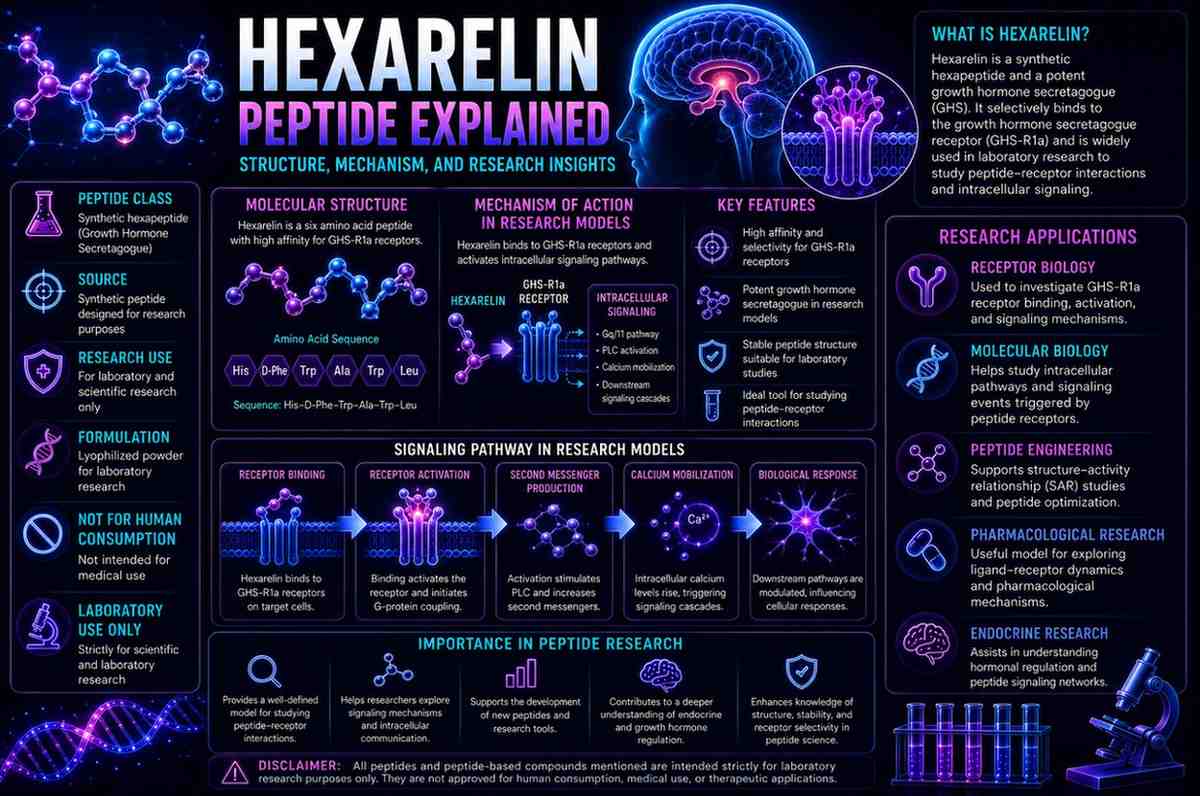
Hexarelin is a synthetic hexapeptide belonging to the family of growth hormone secretagogues. It was developed to investigate how peptide ligands interact with the growth hormone secretagogue receptor (GHS-R1a) and to improve scientific understanding of receptor-mediated biological signaling.
Researchers utilize Hexarelin in controlled laboratory environments to study peptide–receptor interactions, intracellular communication, and structure–activity relationships.
Molecular Structure of Hexarelin
Hexarelin consists of a carefully engineered sequence of six amino acids designed to provide high affinity for GHS-R1a receptors.
These characteristics make Hexarelin valuable for studies examining peptide engineering and molecular recognition.
Mechanism of Action in Research Models
Laboratory studies investigate several molecular mechanisms associated with Hexarelin.
Researchers examine how Hexarelin selectively binds to growth hormone secretagogue receptors and initiates intracellular signaling cascades.
Intracellular Signal Transduction
Experimental models investigate downstream signaling pathways activated following receptor engagement.
Peptide–Receptor Communication
Scientists explore how receptor activation influences communication between signaling proteins and regulatory molecules.
Structur Activity Relationship Studies
Hexarelin is frequently used to investigate how subtle modifications in peptide structure influence receptor affinity and signaling efficiency.
Hexarelin is investigated across multiple areas of peptide science.
Researchers study receptor activation, ligand specificity, and signal transduction mechanisms.
Experimental studies examine intracellular communication pathways initiated by peptide–receptor interactions.
Scientists investigate how structural modifications affect peptide stability, receptor binding, and biological activity.
Hexarelin serves as a valuable laboratory model for understanding ligand–receptor dynamics and peptide design.
Importance of Synthetic Research Peptides
Synthetic peptides such as Hexarelin provide researchers with highly controlled models for studying receptor biology and molecular communication. Their defined structures allow scientists to investigate peptide recognition, signaling efficiency, and receptor selectivity with greater precision.
These investigations continue to improve scientific understanding of peptide engineering and receptormediated biological processes.
Hexarelin remains an important subject in peptide research because of its receptor specificity, engineered structure, and well-characterized molecular interactions. Ongoing laboratory investigations continue to expand knowledge of peptide signaling, receptor biology, and intracellular communication.
As peptide science evolves, Hexarelin continues to serve as a valuable model for understanding how synthetic peptides interact with complex biological signaling systems.
All peptides mentioned are intended strictly for laboratory research purposes only. They are not approved for human consumption, medical use, or therapeutic applications.