Peptide and protein analog research has expanded significantly in the study of cellular signaling and growth-related pathways. Among the compounds frequently examined in laboratory environments is IGF-1 LR3, a modified form of insulin-like growth factor-1 (IGF-1) designed for altered receptor interaction and extended biological activity in experimental models. This article explores IGF-1 LR3’s structure, mechanism of action, and research applications.
What Is IGF-1 LR3?
IGF-1 LR3 (Long R3 Insulin-like Growth Factor-1) is a synthetic analog of naturally occurring IGF-1. It has been modified to enhance stability and reduce binding to certain regulatory proteins, making it particularly useful in research settings investigating growth-related signaling pathways.
Chemical Type: Recombinant protein analog
Structure Class: Modified IGF-1 variant
Primary Research Focus: Cellular growth signaling and receptor pathway studies
Molecular Structure of IGF-1 LR3
IGF-1 LR3 differs from native IGF-1 through specific structural modifications:
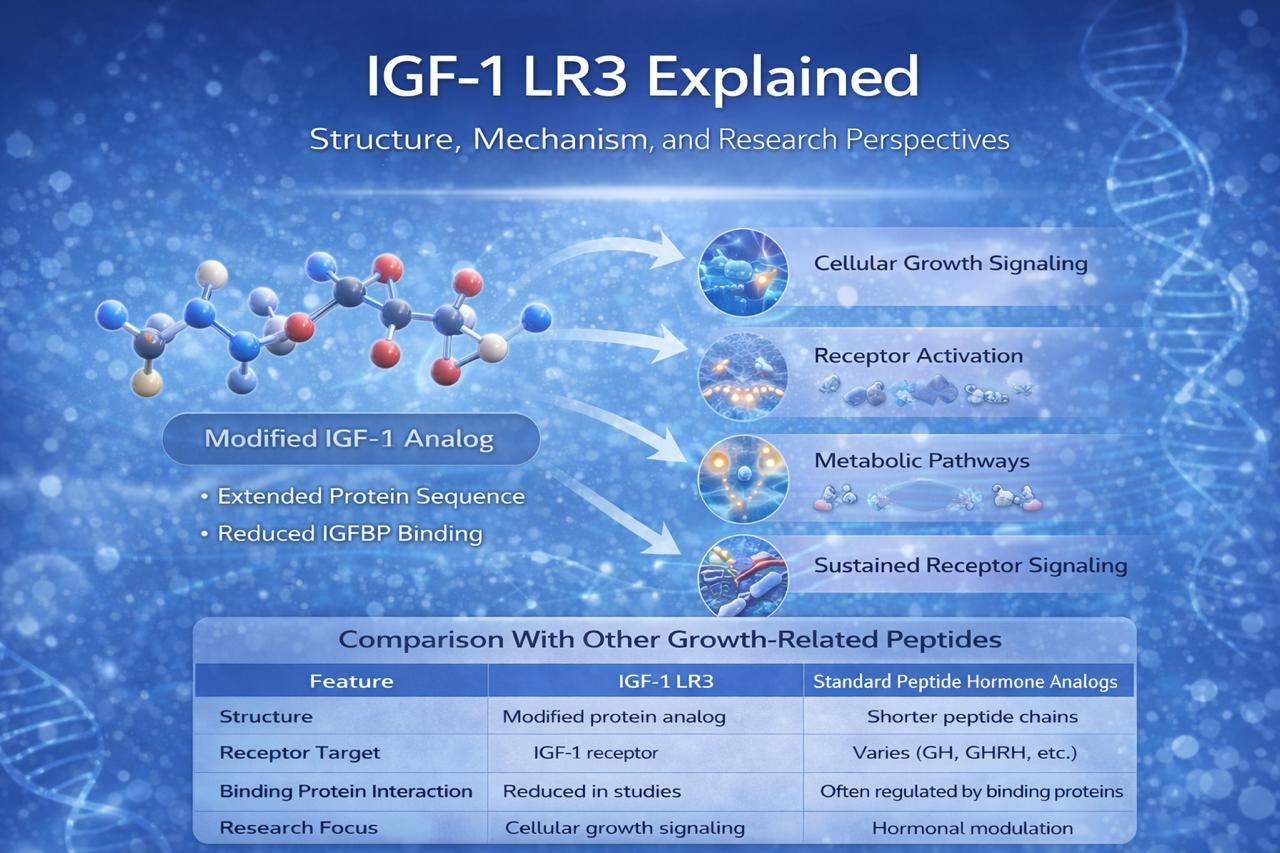
- Extended amino acid sequence compared to natural IGF-1
- Reduced affinity for IGF-binding proteins (IGFBPs) in research models
- Structural adjustments that support prolonged interaction with target receptors
These changes help researchers examine signaling without rapid regulatory binding that occurs with endogenous IGF-1.
Mechanism of Action (Research Context)
IGF-1 LR3 is studied primarily for its interaction with the IGF-1 receptor (IGF-1R), a receptor involved in cellular growth and signaling pathways.
Research-Observed Mechanisms
- Receptor Binding – IGF-1 LR3 binds to IGF-1 receptors on cell surfaces.
- Signal Cascade Activation – Binding triggers intracellular pathways such as PI3K/Akt and MAPK signaling cascades in laboratory models.
- Cellular Growth Signaling – These pathways are associated with cell proliferation and metabolic signaling processes in research systems.
- Reduced Regulatory Limitation – Lower interaction with binding proteins allows sustained receptor signaling in experimental conditions.
These properties make IGF-1 LR3 an important compound in cellular signaling research.
Research Areas Involving IGF-1 LR3
IGF-1 LR3 is not approved as a therapeutic substance but is widely used in controlled laboratory studies.
1. Cellular Growth Pathway Studies
Researchers explore how growth factor signaling influences cellular behavior.
2. Receptor Signaling Research
It is used in experiments examining IGF-1 receptor activation and downstream pathways.
3. Metabolic Signaling Models
IGF-related pathways are relevant in studies involving metabolic regulatory networks.
4. Molecular Biology Research
Its interaction with intracellular signaling cascades makes it important in pathway analysis.
Comparison With Other Growth-Related Peptides
Feature | IGF-1 LR3 | Standard Peptide Hormone Analogs |
Structure | Modified protein analog | Shorter peptide chains |
Receptor Target | IGF-1 receptor | Varies (GH, GHRH, etc.) |
Binding Protein Interaction | Reduced in studies | Often regulated by binding proteins |
Research Focus | Cellular growth signaling | Hormonal modulation |
This comparison highlights IGF-1 LR3’s role as a growth factor analog rather than a traditional peptide hormone.
Stability and Laboratory Handling
In research environments:
- Store at recommended low temperatures
- Avoid repeated freeze–thaw cycles
- Use sterile laboratory-grade solvents for preparation
- Handle carefully due to protein structure sensitivity
Proper storage ensures experimental consistency.
Current Research Status
IGF-1 LR3 remains a research-use-only compound. Ongoing investigations examine:
- Growth factor receptor signaling
- Intracellular pathway activation
- Cellular proliferation models
- Comparative signaling with native IGF-1
Its modified structure keeps it relevant in advanced cell biology research.
Final Thoughts
IGF-1 LR3 is a valuable tool in research exploring cellular growth pathways, receptor signaling, and molecular biology. Its structural modifications allow scientists to study growth factor activity with reduced regulatory interference. As peptide and protein analog research advances, IGF-1 LR3 continues to support deeper understanding of complex biological signaling systems.
Disclaimer:
This compound is intended strictly for laboratory research purposes. It is not approved for human or veterinary use and is not intended to diagnose, treat, cure, or prevent any disease.