Peptide research continues to uncover the importance of short amino acid sequences in cellular communication, molecular signaling, and biological regulation. Among the peptides receiving increasing scientific attention is KPV, a naturally derived tripeptide investigated in laboratory settings for its interaction with signaling pathways and protein-mediated communication systems.
Because of its compact structure and distinct biochemical properties, KPV has become an important subject in modern peptide research focused on understanding molecular regulation and peptide biology.
What is KPV?
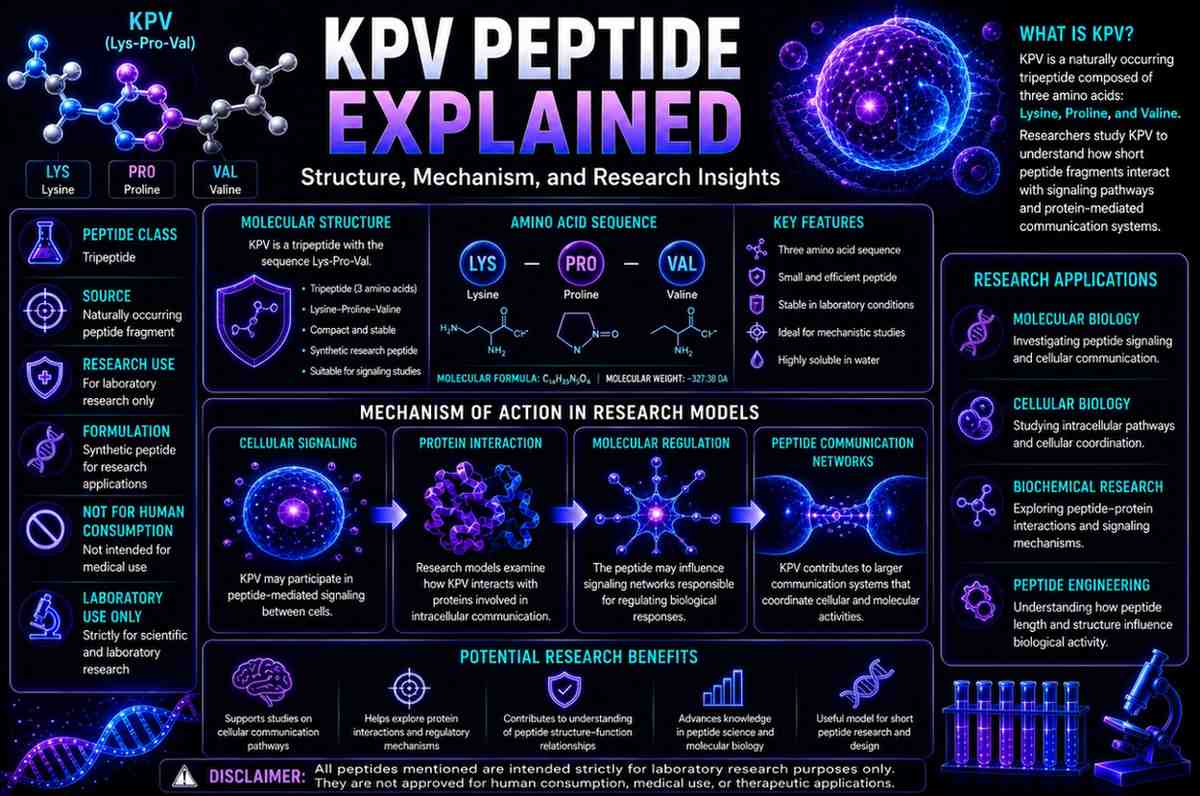
KPV is a synthetic version of a naturally occurring tripeptide composed of three amino acids: Lysine, Proline, and Valine. It represents a biologically active fragment derived from larger peptide molecules involved in cellular signaling.
Researchers study KPV to understand how short peptide fragments interact with molecular pathways responsible for coordinating biological communication and protein signaling.
Molecular Structure of KPV
KPV is one of the smallest research peptides currently investigated in molecular biology.
Its simple structure allows researchers to investigate how very small peptides participate in complex biological signaling systems.
Mechanism of Action in Research Models
Experimental studies suggest that KPV interacts with several molecular communication pathways.
Researchers investigate how KPV participates in communication between cells through peptide-mediated signaling pathways.
Laboratory models examine how the peptide interacts with proteins involved in intracellular communication.
Scientists study KPV’s influence on signaling networks responsible for coordinating biological responses.
Peptide Communication Networks
Research continues to explore how short peptides contribute to larger cellular communication systems and molecular regulation.
KPV is studied across multiple areas of laboratory research.
Researchers investigate peptide-mediated signaling and cellular communication.
Scientists examine interactions between KPV and intracellular regulatory pathways.
Studies focus on peptide structure, molecular recognition, and signaling mechanisms.
Researchers use KPV to better understand how peptide length and structure influence biological activity.
Short peptides provide valuable research tools because they allow scientists to investigate fundamental principles of molecular signaling using relatively simple structures.
Studies involving KPV continue to improve our understanding of peptide biology, cellular coordination, and protein communication systems.
KPV represents an important area of peptide research due to its remarkably compact structure and relevance in molecular signaling studies. Ongoing laboratory investigations continue to expand scientific knowledge regarding peptide-mediated communication and biological regulation.
As peptide science advances, KPV remains a valuable model for understanding how small peptide fragments contribute to complex cellular signaling networks.
All peptides mentioned are intended strictly for laboratory research purposes only. They are not approved for human consumption, medical use, or therapeutic applications.