Peptide research continues to advance as scientists explore biologically active molecules that may influence immune signaling and cellular communication. Among these compounds, Thymosin Alpha-1 (Tα1) has emerged as a key subject of interest in laboratory research focused on immune system modulation and cellular regulation.
Due to its naturally occurring origin and involvement in immune-related pathways, Thymosin Alpha-1 is widely studied in experimental models examining host defense mechanisms and cellular signaling processes.
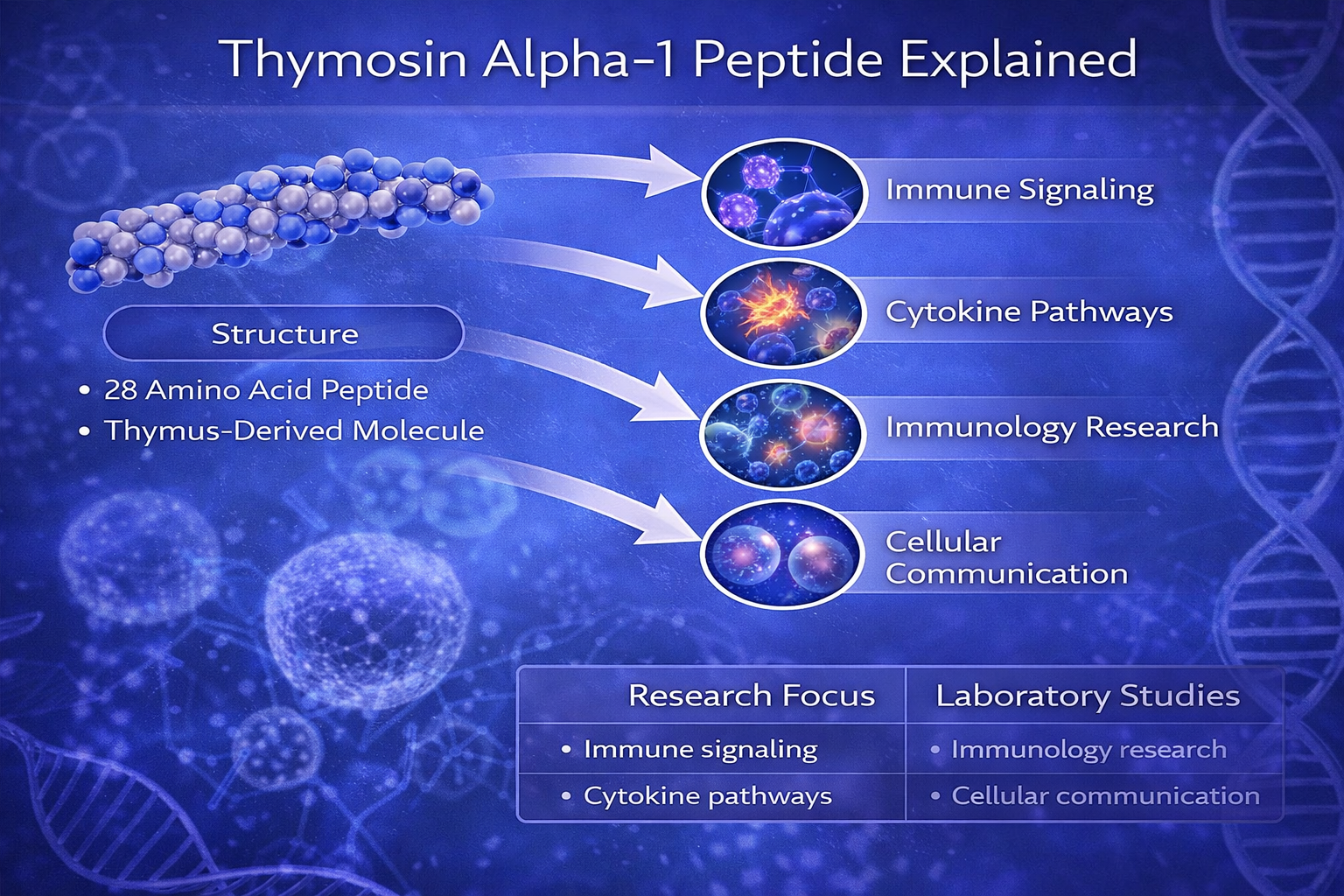
What is Thymosin Alpha-1?
Thymosin Alpha-1 (Tα1) is a naturally occurring peptide originally isolated from the thymus gland, an organ that plays a central role in immune system development.
It is a 28-amino acid peptide that is derived from a larger protein called prothymosin alpha. Researchers study this peptide for its potential involvement in immune signaling pathways and cellular communication systems.
Because of its biological origin, Thymosin Alpha-1 is considered an important molecule in immunological research.
Molecular Structure of Thymosin Alpha-1
Thymosin Alpha-1 is classified as a short polypeptide chain composed of 28 amino acids.
Key structural characteristics include:
- Naturally occurring peptide derived from prothymosin alpha
- Stable linear amino acid sequence
- Water-soluble molecular properties
These features allow researchers to study how the peptide interacts with immune-related receptors and signaling pathways.
Mechanism of Action in Research Models
Laboratory studies suggest that Thymosin Alpha-1 may influence several biological pathways associated with immune function and cellular signaling.
Immune System Modulation
Research models indicate that Thymosin Alpha-1 may interact with pathways involved in immune cell activation and regulation, particularly in T-cell function.
Cytokine Signaling
Scientists investigate how the peptide may influence cytokine production, which plays a key role in communication between immune cells.
Cellular Communication
Thymosin Alpha-1 is also studied for its role in cellular signaling pathways, helping researchers understand how immune responses are coordinated.
Innate and Adaptive Immunity
Experimental research explores how the peptide may interact with both innate and adaptive immune systems, contributing to broader immune response mechanisms.
Research Applications
Due to its involvement in immune-related pathways, Thymosin Alpha-1 is studied in various research areas.
Immunology Research
Scientists investigate how the peptide influences immune system signaling and regulation.
Infection and Immune Response Studies
Research models explore how the peptide interacts with pathways involved in host defense mechanisms.
Cellular Signaling Studies
Thymosin Alpha-1 is used in laboratory settings to examine cell-to-cell communication and immune coordination.
Importance of Immune-Modulating Peptides
Understanding immune system regulation is essential for advancing biological research. Peptides like Thymosin Alpha-1 allow scientists to study how immune responses are triggered, controlled, and maintained at the molecular level.
By analyzing these pathways, researchers gain insight into how the body responds to external and internal challenges.
Final Thoughts
Thymosin Alpha-1 remains an important peptide in modern scientific research due to its role in immune system signaling and cellular communication. Its naturally occurring origin and well-defined structure make it a valuable compound for studying immune regulation and biological response mechanisms.
As peptide research continues to evolve, Thymosin Alpha-1 provides a strong foundation for understanding how small molecular signals influence complex physiological systems.
Disclaimer
All peptides mentioned are intended strictly for laboratory research purposes only. They are not approved for human consumption, medical use, or therapeutic applications.