Peptide research continues to expand our understanding of neuroendocrine communication, receptor signaling, and interactions between the nervous and gastrointestinal systems. Among the naturally occurring peptides investigated in laboratory settings is Neurotensin, a signaling peptide studied for its interactions with specific G-protein-coupled receptors and its role in complex molecular communication pathways.
Its distinctive structure and broad distribution in biological tissues have made Neurotensin an important subject in neuroscience, molecular biology, and peptide receptor research.
What is Neurotensin?
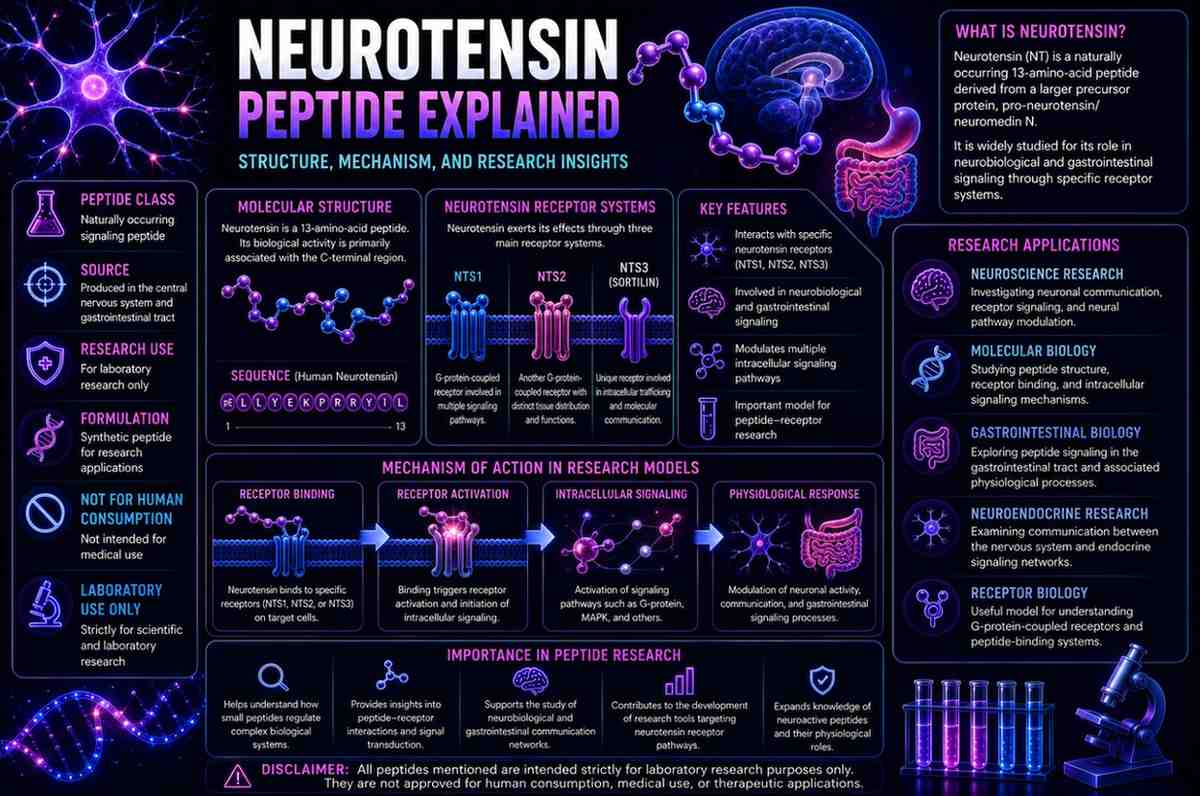
Neurotensin (NT) is a naturally occurring peptide originally identified in the nervous system. It is produced from a larger precursor protein known as pro-neurotensin/neuromedin N.
Researchers study Neurotensin to better understand how peptide signaling molecules interact with receptors and influence communication between neurons and other cell types.
Neurotensin is particularly interesting because it is associated with signaling systems in both the central nervous system and the gastrointestinal tract.
Molecular Structure of Neurotensin
Neurotensin is a 13-amino-acid peptide. Its biological activity is primarily associated with the C-terminal region of the peptide.
The peptide’s structure provides researchers with a useful model for investigating how sequence-specific interactions influence receptor recognition and signaling.
Neurotensin Receptor Systems
Neurotensin research commonly focuses on three receptor types:
NTS1 is a G-protein-coupled receptor that has been extensively investigated for its role in Neurotensin-mediated cellular signaling.
NTS2 is another receptor system studied for its interactions with Neurotensin and related signaling pathways.
NTS3, also known as sortilin, differs structurally from the classical G-protein-coupled receptors and is investigated for its involvement in intracellular trafficking and molecular communication.
The diversity of these receptor systems makes Neurotensin valuable for studying different mechanisms of peptide signaling.
Mechanism of Action in Research Models
Laboratory research investigates several mechanisms through which Neurotensin interacts with biological systems.
Researchers study how Neurotensin binds to receptor systems and activates intracellular signaling pathways.
Experimental models examine Neurotensin’s role in communication between neurons and other cells within the nervous system.
Scientists investigate the peptide’s interactions with signaling pathways associated with the gastrointestinal tract.
Research explores how receptor activation can influence downstream molecular pathways and cellular responses.
Neurotensin is studied across multiple scientific disciplines.
Researchers investigate peptide-mediated communication within neural systems and receptor signaling pathways.
Scientists study the relationship between peptide structure, receptor binding, and intracellular signaling.
Experimental studies examine communication between the nervous system and endocrine signaling networks.
Researchers investigate peptide signaling mechanisms associated with the gastrointestinal system.
Neurotensin provides a useful model for studying G-protein-coupled receptors and other peptide-binding systems.
Importance of Neuroactive Peptides
Neuroactive peptides such as Neurotensin demonstrate how relatively small molecules can coordinate complex biological communication networks.
By studying Neurotensin and its receptors, scientists can gain valuable insights into peptide-receptor interactions, intracellular signaling, and communication between different biological systems.
This research also contributes to a broader understanding of how naturally occurring peptides function as signaling molecules throughout the body.
Neurotensin remains an important subject in peptide science because of its unique structure, diverse receptor systems, and involvement in neurobiological and gastrointestinal signaling research.
Continued laboratory investigation of Neurotensin may provide further insights into peptide-receptor interactions, molecular communication, and the complex signaling networks that connect different biological systems.
All peptides and peptide-related compounds mentioned are intended strictly for laboratory research purposes only. They are not approved for human consumption, medical use, or therapeutic applications.