Peptide research continues to expand our understanding of molecular signaling, receptor interactions, and communication between cells. Among the naturally occurring signaling peptides studied in laboratory settings is Peptide YY (PYY), a peptide investigated for its interactions with specific receptors and its role in biological signaling networks.
Because of its distinctive molecular structure and receptor-mediated activity, PYY has become an important subject in research involving gastrointestinal signaling, neuroendocrine communication, and peptide biology.
What is Peptide YY?
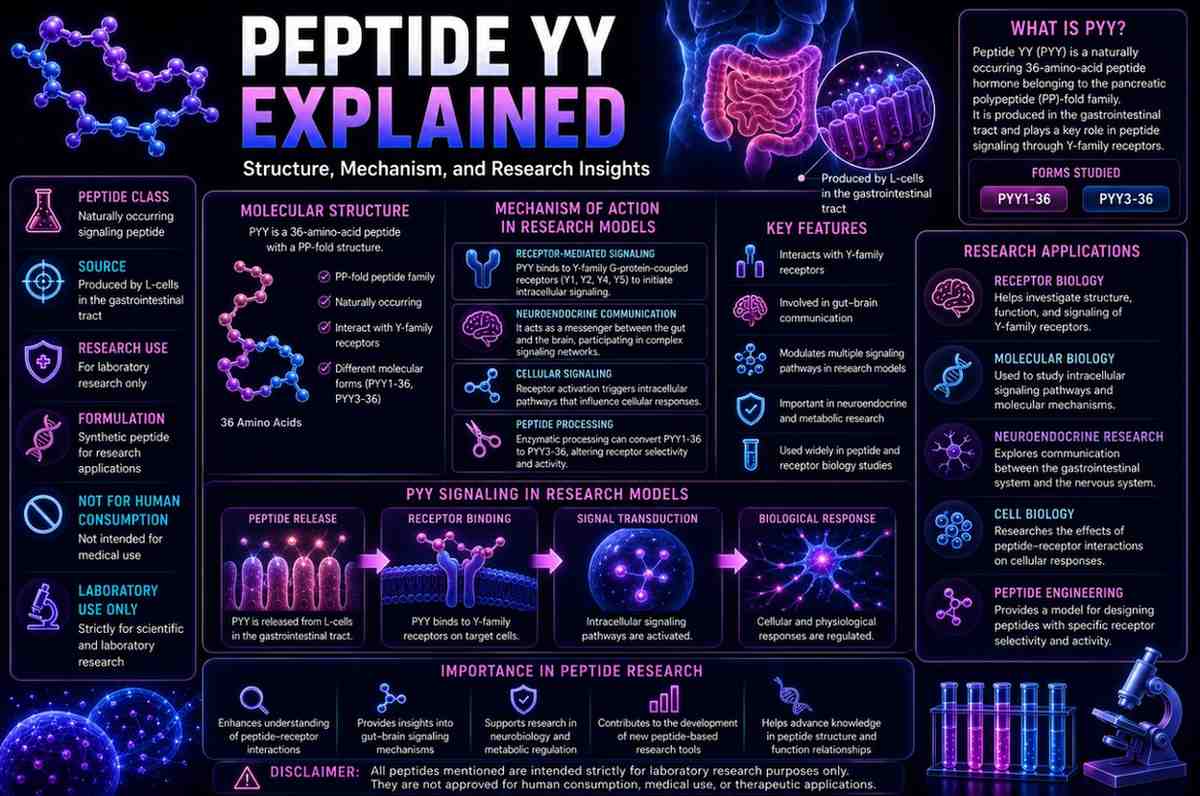
Peptide YY (PYY) is a naturally occurring peptide hormone belonging to the pancreatic polypeptide (PP)-fold family of peptides.
It is primarily produced by specialized cells in the gastrointestinal tract and has been studied for its interactions with the Y family of G-protein-coupled receptors (Y receptors).
Researchers investigate PYY to better understand how peptide signaling molecules communicate with receptors and influence biological processes across different tissues.
PYY is a 36-amino-acid peptide that shares structural similarities with other members of the PP-fold family, including neuropeptide Y and pancreatic polypeptide.
PYY can exist in different molecular forms, with PYY1-36 and PYY3-36 being among the forms investigated in scientific research.
Mechanism of Action in Research Models
Researchers study PYY primarily through its interactions with Y-family receptors.
PYY interacts with specific G-protein-coupled receptors, allowing scientists to investigate how peptide binding triggers intracellular signaling pathways.
Experimental studies examine how PYY participates in communication between the gastrointestinal system and the nervous system.
Researchers investigate how receptor activation influences intracellular molecular pathways and cellular responses.
Scientists also study how enzymatic processing can alter the structure of PYY and affect its receptor selectivity and biological activity.
PYY is studied across several scientific disciplines.
Researchers use PYY to investigate the structure and function of Y-family G-protein-coupled receptors.
Scientists examine the signaling pathways activated following peptide–receptor interactions.
Laboratory studies explore communication between gastrointestinal tissues and neural signaling systems.
PYY provides researchers with a useful model for studying how peptide structure influences receptor selectivity and signaling.
Importance of Peptide Signaling Research
Signaling peptides such as PYY demonstrate how relatively small molecules can coordinate communication across complex biological systems.
By studying PYY and related peptides, researchers can better understand receptor activation, molecular signaling, peptide processing, and the relationship between peptide structure and biological activity.
This research also contributes to the broader study of G-protein-coupled receptors, one of the largest families of signaling receptors in biology.
Peptide YY remains an important subject in peptide and receptor research due to its distinctive structure and interaction with Y-family receptors. Its study provides valuable insights into peptide-mediated signaling, neuroendocrine communication, and molecular regulation.
As peptide science continues to evolve, PYY remains a useful model for understanding how naturally occurring signaling molecules communicate with cells and receptors throughout complex biological systems.
All peptides and peptide-related compounds mentioned are intended strictly for laboratory research purposes only. They are not approved for human consumption, medical use, or therapeutic applications.