

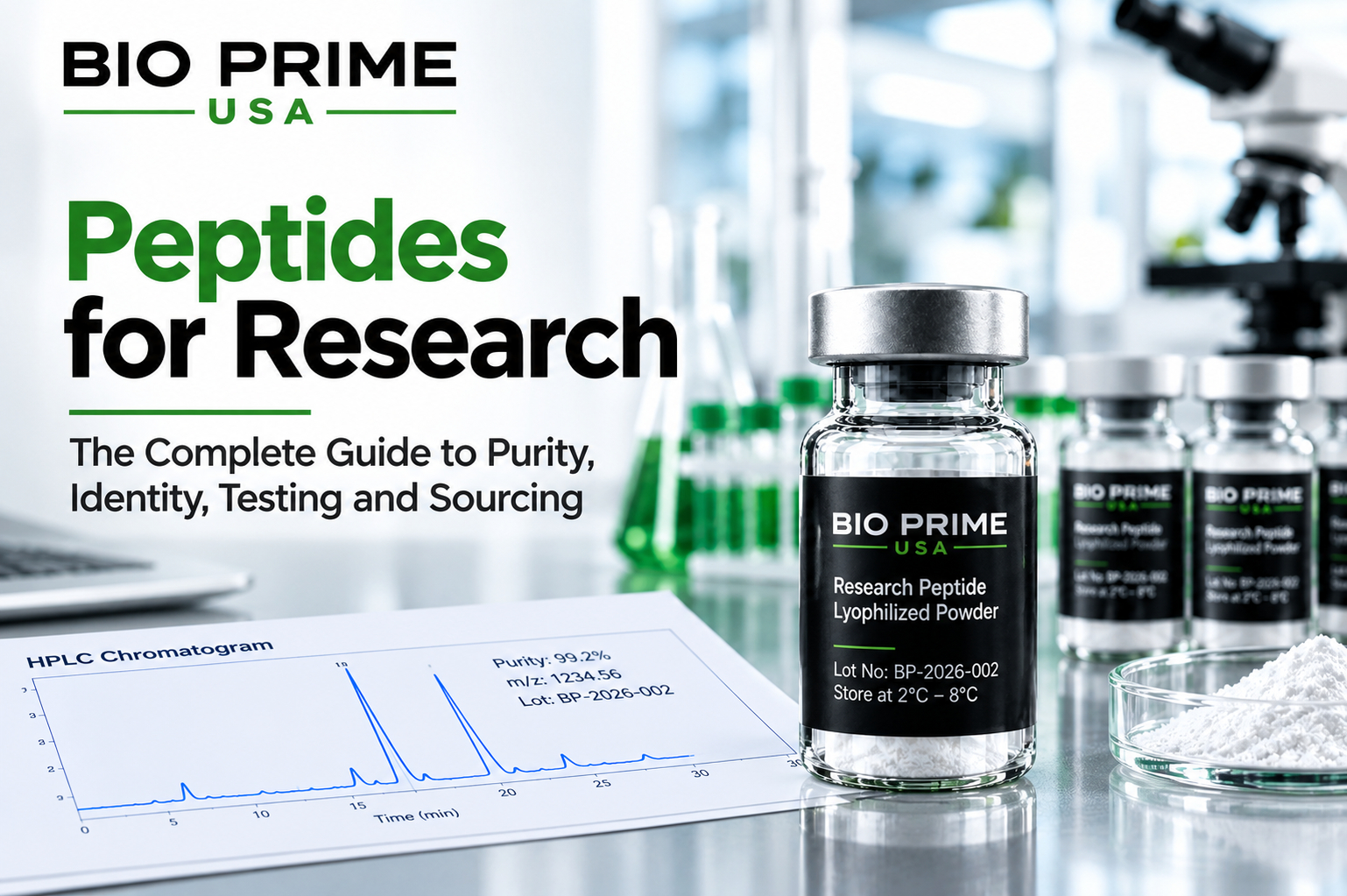
BioPrime USA peptides for research vials alongside HPLC analysis visuals, highlighting peptide purity, identity verification, analytical testing, and responsible sourcing of research materials.
Peptides for Research: Quality, Testing and Sourcing Guide
Peptides for research are short chains of amino acids used in laboratory work such as assay development, analytical method development and biochemical studies. A product name or a price says very little about what is actually in a vial, so the quality of any research material depends on its documentation: how its identity was confirmed, how its purity was measured, and whether the paperwork matches the lot that arrives. This guide explains what research peptides are, how they are made and tested, how to read a Certificate of Analysis (COA), and how to evaluate a supplier. Everything described here applies to laboratory research use only, not to human or veterinary use.
Quick answer: what should you check before ordering research peptides?
Confirm the stated identity of the peptide, how purity was measured and by which method, whether a COA matches the specific lot number, how the material is stored and shipped, and whether the supplier states a clear research-use-only limitation. No single result proves every quality attribute.
What Are Peptides?
A peptide is a molecule made of amino acids joined by peptide bonds, the covalent links between the carboxyl group of one amino acid and the amino group of the next. The order of the amino acids is the peptide’s amino acid sequence, and that sequence defines its molecular identity.
Most peptides for research are produced synthetically rather than extracted from tissue. Chemical synthesis lets a laboratory specify an exact sequence, which in turn gives the material a calculable molecular mass and measurable analytical properties. Those properties are what make it possible to test whether a sample matches its label.
Peptides, oligopeptides and proteins
The terms overlap. Short chains of roughly two to twenty amino acids are often called oligopeptides, intermediate chains are simply called peptides, and long, folded chains are usually called proteins. These boundaries are conventions, not strict rules. For a researcher, the practical point is that a peptide with a defined sequence can be verified analytically, while a vague product description cannot.
What Does “Research Use Only” Mean?
Research use only (RUO) means a material is intended for laboratory investigation and not for administration to humans or animals, or for diagnosing, treating or preventing disease. An RUO label is a statement of intended use. It is not a statement that the material has been evaluated for safety or efficacy in people.
This distinction shapes how peptides for research should be described and bought. Reputable sources describe their materials through analytical documentation, such as identity, purity and lot records, rather than through health or performance claims. If a seller attaches therapeutic promises to a research material, treat that as a warning sign about the seller, not as evidence about the product.
How Research Peptides Are Made: From Sequence to Vial
Understanding production explains why testing matters. The usual chain runs from sequence design to synthesis, cleavage, purification, lyophilization, characterization and batch documentation.
- Sequence design. The target amino acid sequence is specified.
- Solid-phase peptide synthesis (SPPS). Amino acids are added one at a time to a chain anchored on a solid resin. The method was introduced by Bruce Merrifield, who received the 1984 Nobel Prize in Chemistry for it.
- Cleavage. The finished chain is released from the resin and protecting groups are removed.
- Purification. The crude product contains truncated and modified sequences, so it is commonly purified by reversed-phase preparative HPLC, as described in this Cold Spring Harbor Protocols method.
- Lyophilization. Freeze-drying removes solvent and leaves a stable powder that is easier to store and ship.
- Characterization. Analytical methods such as HPLC and mass spectrometry evaluate purity and molecular identity.
- Batch documentation. Results are recorded against a lot number, usually in a COA.
Each step can introduce variation, which is why lot-specific documentation is more informative than a generic product description.
Categories of Peptides Studied in the Laboratory
Several peptide families appear regularly in the research literature. Examples include growth hormone-releasing hormone (GHRH) analogs such as CJC-1295, growth hormone secretagogue peptides such as ipamorelin and GHRP-6, and signaling peptides such as kisspeptin and apelin. These names describe sequences and compound classes. They are not endorsements of any use, and this guide makes no claims about biological effects in people.
When reviewing peptides for research in any of these categories, the same questions apply: Is the sequence correctly identified? How was purity measured? Does the documentation belong to the lot being supplied? For compound-specific background, primary literature indexed in PubMed and compound records in PubChem are better starting points than supplier marketing.
Where Peptides Are Used in the Laboratory
Research peptides serve several non-clinical purposes:
- Assay development, where a defined peptide acts as a standard or substrate.
- Analytical method development, including chromatography and mass spectrometry workflows.
- In vitro binding and signaling studies, where receptor-peptide interactions are examined in cell-free or cell-based systems.
- Stability and formulation studies, which examine how a peptide behaves under different storage conditions.
In each case, reproducibility depends on knowing exactly what material was used, which brings the discussion back to documentation. For background on methods and terminology, see BioPrime USA’s educational resources.
Peptides for Research: Evaluating Quality Before You Order
No single number defines quality. The seven checks below help researchers compare sources on evidence instead of presentation.
- Stated identity. The peptide name, sequence or molecular formula should be clear and consistent across the product page and the COA.
- Purity method. A purity figure means little without the method behind it. Look for the analytical technique and conditions.
- HPLC profile. A chromatogram shows how many components were detected and how dominant the main peak is.
- Mass spectrometry result. The observed mass should be consistent with the expected molecular mass of the peptide.
- Lot-matched COA. The report should carry the same lot number as the material you receive.
- Traceability. A batch should connect to its production and testing records.
- Intended-use statement. Clear research-use-only wording signals that the supplier understands the limits of what it sells.
Treat these as a set. A high purity percentage with no method, no lot number and no mass data is much weaker evidence than a complete, lot-matched report. The same approach is described in more practical detail in BioPrime USA’s guide to buying peptides online for research.
Compare Research Materials on Documentation
Check identity, purity method and lot records before you choose a research material.
Browse BioPrime USA’s research-use-only catalog and review each product’s stated intended use and available documentation.
HPLC vs. Mass Spectrometry: What Each Test Shows
What is HPLC? High-performance liquid chromatography (HPLC) is an analytical separation technique commonly used to evaluate the chromatographic profile of a laboratory sample. It separates components as they move through a column and reports each as a peak.
What is mass spectrometry? Mass spectrometry (MS) measures the mass-to-charge ratio of ions and supports assessment of a molecule’s mass. In liquid chromatography-mass spectrometry (LC-MS), a chromatographic separation is paired with mass detection.
| Method | What it can support | What it does not establish on its own |
|---|---|---|
| HPLC | Chromatographic purity under stated conditions; number and relative size of detected components | Molecular identity or full sequence confirmation |
| Mass spectrometry | Consistency of observed mass with the expected molecular species | Purity, or every structural feature |
| Batch-specific COA | Documented results tied to a named lot | Attributes that were not tested |
| Several methods combined | Complementary evidence about identity and purity | Proof of every possible property |
The relationship is complementary. HPLC asks how many things are in the sample and in what proportion. Mass spectrometry asks whether the main component has the expected mass. Neither replaces the other, and neither tests properties such as sterility or endotoxin unless those tests are specifically run.
How to Read a Certificate of Analysis (COA)
A Certificate of Analysis is a document reporting tested attributes for a specific material or lot. A useful COA lets you verify that the data describes what you are holding.
Check these fields in order:
- Product name and identifiers, matching the product you ordered.
- Lot or batch number, matching your vial or packing record.
- Test date, so you know when the analysis was done.
- Method, such as HPLC conditions or the mass spectrometry approach.
- Result, including how purity was calculated.
- Observed versus expected mass, where mass spectrometry was reported.
A COA proves only what was tested. A page of results for a different lot, or a generic certificate with no lot number, is not evidence about your material. BioPrime USA publishes analytical documentation in its COA & Test Results section, and researchers should still confirm that any report matches the specific lot in hand.
Storage, Stability and Reconstitution Basics
Lyophilized peptides are generally more stable than peptides in solution, which is one reason they are supplied as freeze-dried powder. Storage requirements vary by sequence, so the product-specific instructions take priority over any general rule.
Common laboratory practice for lyophilized material is to keep it cold, dry and protected from light, to let a vial reach room temperature before opening to limit condensation, and to avoid repeated freeze-thaw cycles after reconstitution. Reconstitution means dissolving the powder in an appropriate solvent according to the laboratory’s own protocol. Record the date, solvent and lot number so later results can be traced to the exact material.
Sourcing Peptides for Research: What to Look for in a Supplier
Once the technical questions are clear, supplier evaluation becomes a documentation exercise. Compare suppliers on the following:
- Clear product descriptions with a stated sequence or identity
- Accessible, lot-specific analytical results
- Transparent research-use-only language
- Educational resources that explain methods and limits
- Responsive support for documentation questions
US-made versus imported
Domestic manufacturing can simplify shipping times and make it easier to ask questions about production, but origin alone does not prove quality. A US-made label with no lot-matched COA is weaker evidence than an imported product with complete documentation.
Buying in bulk
Larger quantities suit repeated experiments and longer projects. Before ordering peptides for research in bulk, consider stability over the intended storage period, whether one lot will cover the full study, and how the lot’s documentation will be archived.
BioPrime USA offers research-use-only materials through its research product catalog, a Build Your Own Kit option, and a Knowledge Hub of educational material.
Red Flags When Sourcing Research Peptides
- Therapeutic, dosing or body-composition claims on a research product
- Purity percentages with no method or lot number
- A single generic certificate used for many products
- No research-use-only statement
- Unrealistic guarantees such as “proven to work” or “100% safe”
- No way to ask about documentation
Any one of these is a reason to look more closely before ordering.
Frequently Asked Questions
1. What are research peptides?
Research peptides are laboratory materials made of amino acid chains, used for analytical, assay and method-development work. They are intended for research use only, not for human or veterinary administration.
2. Are peptides for research intended for human use?
No. Research-use-only materials are not for human or veterinary administration, diagnosis, treatment or disease prevention. Researchers should review the product’s stated intended use and applicable laws before purchasing.
3. What does research use only (RUO) mean?
RUO means the material is intended for laboratory investigation. The label states intended use and does not imply evaluation for safety or efficacy in people.
4. How can I tell whether a research peptide is high quality?
Review the stated identity, the purity method, HPLC and mass spectrometry data, a COA matching the lot number, and the supplier’s traceability and intended-use statements together.
5. What is a peptide COA?
A Certificate of Analysis reports tested attributes for a specific lot. Check the product name, lot number, test date, method and results, and confirm the report belongs to your material.
6. Does an HPLC purity result prove identity?
No. HPLC shows chromatographic purity under stated conditions. Identity needs supporting evidence, commonly a mass spectrometry result consistent with the expected molecular mass.
7. What is the difference between HPLC and mass spectrometry?
HPLC separates sample components and shows their relative proportions. Mass spectrometry measures mass-to-charge ratio and supports molecular identity. They answer different questions and work best together.
8. Why are research peptides lyophilized?
Freeze-drying removes solvent and generally improves stability during storage and shipping, since peptides tend to degrade faster in solution.
9. How should lyophilized research peptides be stored?
Follow the product-specific instructions. General practice is cold, dry, light-protected storage, warming the vial before opening, and avoiding repeated freeze-thaw cycles after reconstitution.
10. Why does the lot number on a COA matter?
The lot number ties analytical results to a specific production batch. Results for a different lot, or a report with no lot number, do not describe your material.
11. What is the difference between research-grade and pharmaceutical-grade peptides?
Research-grade materials are made and labeled for laboratory use. Pharmaceutical products follow separate regulatory and manufacturing frameworks and are not interchangeable with RUO materials.
12. Does a US-made label guarantee quality?
No. Origin can help with logistics and communication, but quality is shown by lot-matched analytical documentation, not by origin alone.
Check the Documentation Before You Order
Match any report to the product and lot you are evaluating.
Review BioPrime USA’s published testing records, or assemble a research-use-only kit for repeated experiments.
Scientific references
Conclusion
Choosing peptides for research is mostly a matter of evaluating evidence. Identity, purity method, HPLC and mass spectrometry data, a lot-matched COA and clear research-use-only wording each answer a different question, and none replaces the others. Researchers who read documentation carefully, store material according to its instructions and record lot numbers will produce more reproducible work.
To review analytical documentation or browse research-use-only materials, visit BioPrime USA’s testing and COA records or its shop of research-use-only materials. Research use only. Not for human or veterinary use.