Peptide research continues to uncover short-chain compounds with intriguing biological signaling roles. Among these, Selank has gained attention in laboratory settings for its relationship with neurochemical modulation and immune signaling pathways. This article explores Selank’s structure, proposed mechanisms, and areas of ongoing research interest.
Note: Selank is intended for research use only. It is not approved for human consumption or medical use.
What Is Selank?
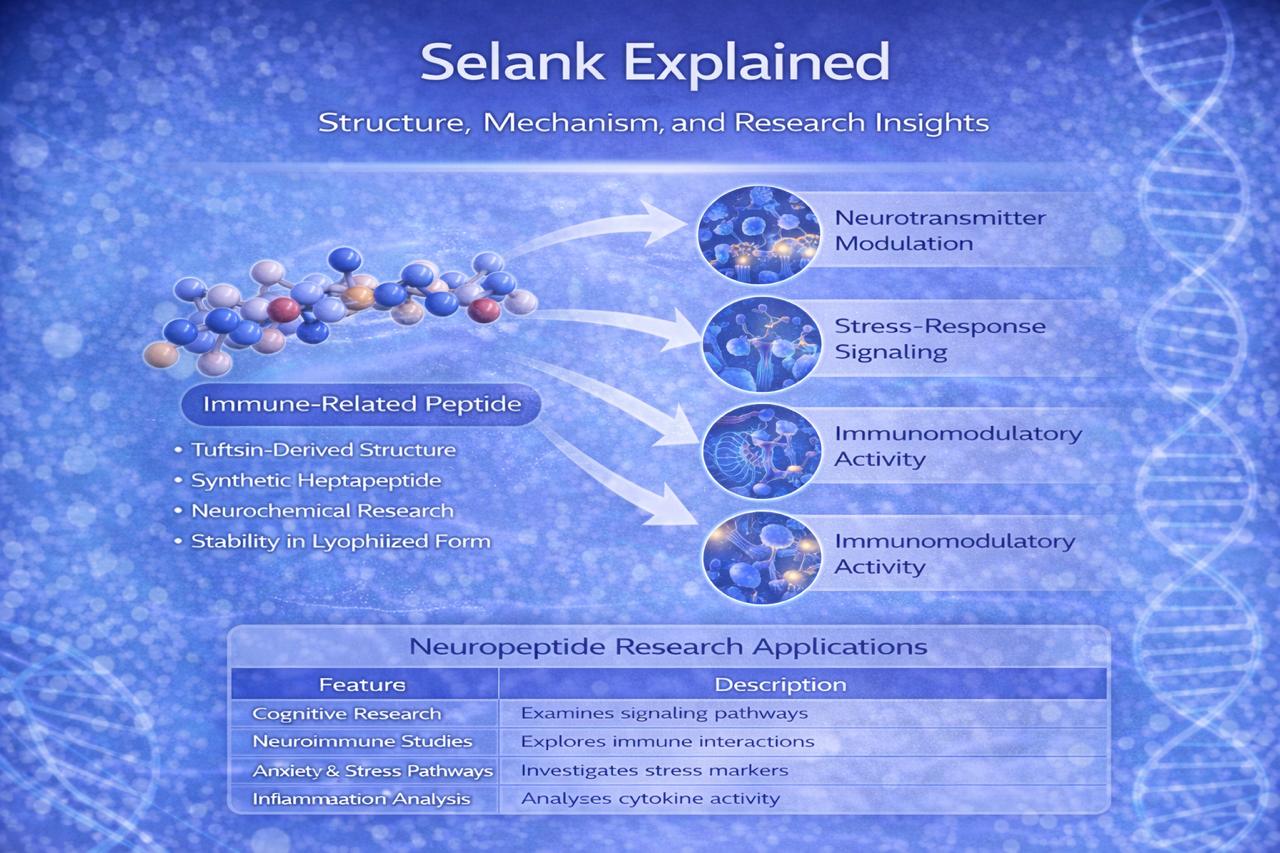
Selank is a synthetic heptapeptide derived from the naturally occurring immunomodulatory peptide tuftsin. It was developed to explore interactions between neuropeptide signaling and immune system pathways.
Researchers study Selank primarily for its potential effects on:
- Neurotransmitter regulation
- Stress-response pathways
- Cognitive signaling mechanisms
- Immune modulation
Its relatively short amino acid chain and stability make it an interesting candidate for peptide research models.
Structural Characteristics
Selank is composed of seven amino acids engineered to enhance stability compared to its natural analogs. Key structural features include:
- Heptapeptide format for targeted receptor interaction
- Tuftsin-derived backbone linked to immune signaling pathways
- Enhanced metabolic stability for extended research observation
These properties allow Selank to be studied in various in-vitro and in-vivo experimental frameworks.
Proposed Mechanism of Action
While research is ongoing, several mechanisms have been proposed based on preclinical studies.
1. Neurotransmitter Modulation
Selank has been observed in laboratory models to influence signaling related to:
- Gamma-aminobutyric acid (GABA) pathways
- Serotonergic activity
- Dopaminergic balance
This has made it a subject of interest in neurochemical research environments.
2. Stress-Response Signaling
Experimental work suggests Selank may interact with pathways involved in:
- Cortisol regulation
- Adaptive stress responses
- Neuroendocrine communication
These findings remain under investigation.
3. Immunomodulatory Activity
Because of its tuftsin origin, Selank is also studied for:
- Cytokine signaling effects
- Immune cell communication
- Inflammatory pathway modulation
Areas of Active Research
Current laboratory research involving Selank often focuses on:
- Cognitive and memory signaling models
- Stress and anxiety pathway research
- Neuroimmune interaction studies
- Peptide stability and delivery systems
It is important to emphasize that much of the work remains preclinical and exploratory.
Selank vs. Semax: Research Context
Selank is frequently discussed alongside Semax due to their shared origin in neuropeptide research. Key distinctions in research literature include:
Feature | Semax | |
Primary research focus | Neuroimmune modulation | Nootropic signaling |
Peptide length | Heptapeptide | Longer ACTH-derived fragment |
Origin | Tuftsin-based | ACTH analog |
Typical lab interest | Stress & immune pathways | Cognitive signaling |
Both peptides continue to be investigated for their unique receptor interactions.
Research Handling Considerations
For laboratory use, researchers typically emphasize:
- Proper cold-chain storage
- Protection from repeated freeze-thaw cycles
- Use of sterile research protocols
- Documentation of batch purity
Always follow your institution’s peptide handling guidelines.
Final Thoughts
Selank represents an intriguing subject in modern peptide research, particularly at the intersection of neurochemistry and immunology. Its tuftsin-derived structure and potential signaling effects continue to drive laboratory interest. As research progresses, additional clarity around its biological interactions and applications may emerge.