Peptide research continues to move beyond traditional hormone-modulating compounds and into the field of cellular energy optimization. One of the most intriguing research peptides in this category is SS-31, also known as Elamipretide. Unlike growth hormone secretagogues or nootropic peptides, SS-31 is studied primarily for its interaction with mitochondrial membranes and cellular bioenergetics.
This article explores SS-31’s structure, proposed mechanism of action, and areas of ongoing scientific investigation.
Disclaimer: SS-31 is intended strictly for laboratory research purposes. It is not approved for human consumption or medical use.
What Is SS-31?
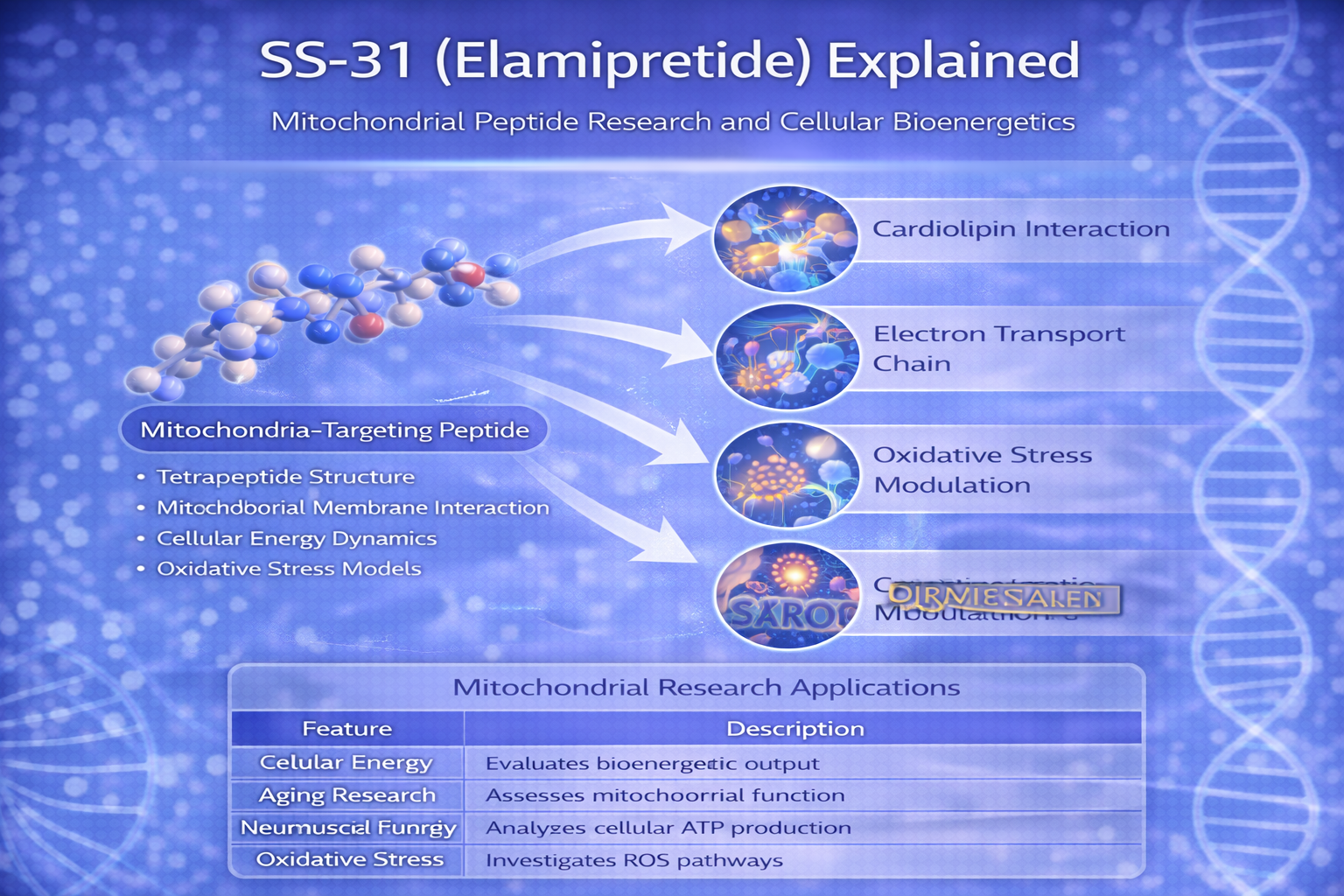
SS-31 is a synthetic tetrapeptide designed to selectively target mitochondria — the energy-producing organelles within cells. It belongs to a class of compounds often referred to as mitochondria-targeting peptides.
Unlike many peptides that act through surface receptors, SS-31 is studied for its ability to penetrate cells and localize within the inner mitochondrial membrane, where it interacts with key lipid components involved in energy production.
Structural Characteristics
SS-31 is a small peptide composed of four amino acids. Its compact structure allows it to:
- Penetrate cellular membranes efficiently
- Accumulate within mitochondria
- Interact with cardiolipin, a lipid unique to the inner mitochondrial membrane
- Remain stable under laboratory conditions
Because of its size and charge distribution, SS-31 has become a valuable tool for researchers studying mitochondrial membrane dynamics.
Proposed Mechanism of Action
In experimental models, SS-31 is investigated for its effects on mitochondrial function. While research is ongoing, several mechanisms have been explored:
1. Cardiolipin Interaction
Cardiolipin is a phospholipid critical to maintaining mitochondrial structure and function. SS-31 is studied for its ability to bind to cardiolipin and stabilize mitochondrial membranes under stress conditions.
2. Electron Transport Chain Support
Researchers examine how SS-31 may influence the efficiency of the electron transport chain (ETC), the system responsible for ATP production within cells.
3. Oxidative Stress Modulation
Mitochondria are a major source of reactive oxygen species (ROS). SS-31 is being studied in laboratory models for its potential influence on oxidative stress pathways and redox balance.
4. Cellular Energy Output
Because mitochondria generate ATP, any modulation of mitochondrial membrane stability may affect cellular energy dynamics. SS-31 is often used in experiments analyzing bioenergetic efficiency.
Areas of Active Research
SS-31 is commonly studied in laboratory settings related to:
- Mitochondrial dysfunction models
- Cellular aging research
- Muscle bioenergetics
- Neurocellular energy metabolism
- Cardiometabolic experimental models
- Oxidative stress pathway analysis
Its targeted mitochondrial activity makes it distinct from peptides that operate through endocrine or receptor-based signaling.
SS-31 vs. Other Research Peptides
Feature | MOTS-c | BPC-157 | |
Primary Target | Mitochondrial membrane | Metabolic pathways | Cellular repair pathways |
Mechanism Focus | Cardiolipin stabilization | AMPK signaling | Growth factor interaction |
Research Category | Bioenergetics | Metabolism | Tissue signaling |
Peptide Size | Tetrapeptide | Mitochondrial-derived peptide | 15 amino acids |
SS-31 stands out because it works at the organelle level, rather than through surface receptor activation.
Laboratory Handling Considerations
In research environments, SS-31 is typically:
- Supplied as a lyophilized powder
- Stored at low temperatures
- Reconstituted using sterile laboratory solvents
- Protected from excessive light and repeated freeze–thaw cycles
Proper handling ensures structural integrity and consistent experimental outcomes.
Why Researchers Are Interested in Mitochondrial Peptides
Mitochondria are central to:
- ATP production
- Apoptotic signaling
- Reactive oxygen species balance
- Cellular stress adaptation
As scientific focus increasingly shifts toward cellular resilience and energy regulation, mitochondria-targeted peptides like SS-31 are gaining attention in laboratory research.
Final Thoughts
SS-31 represents a unique direction in peptide science — one that moves beyond hormone modulation and into the core of cellular energy systems. By targeting mitochondrial membranes directly, this peptide provides researchers with a tool to explore bioenergetics, oxidative stress pathways, and membrane stability in controlled experimental models.
As mitochondrial research expands, SS-31 continues to serve as a compelling compound for scientific investigation.