

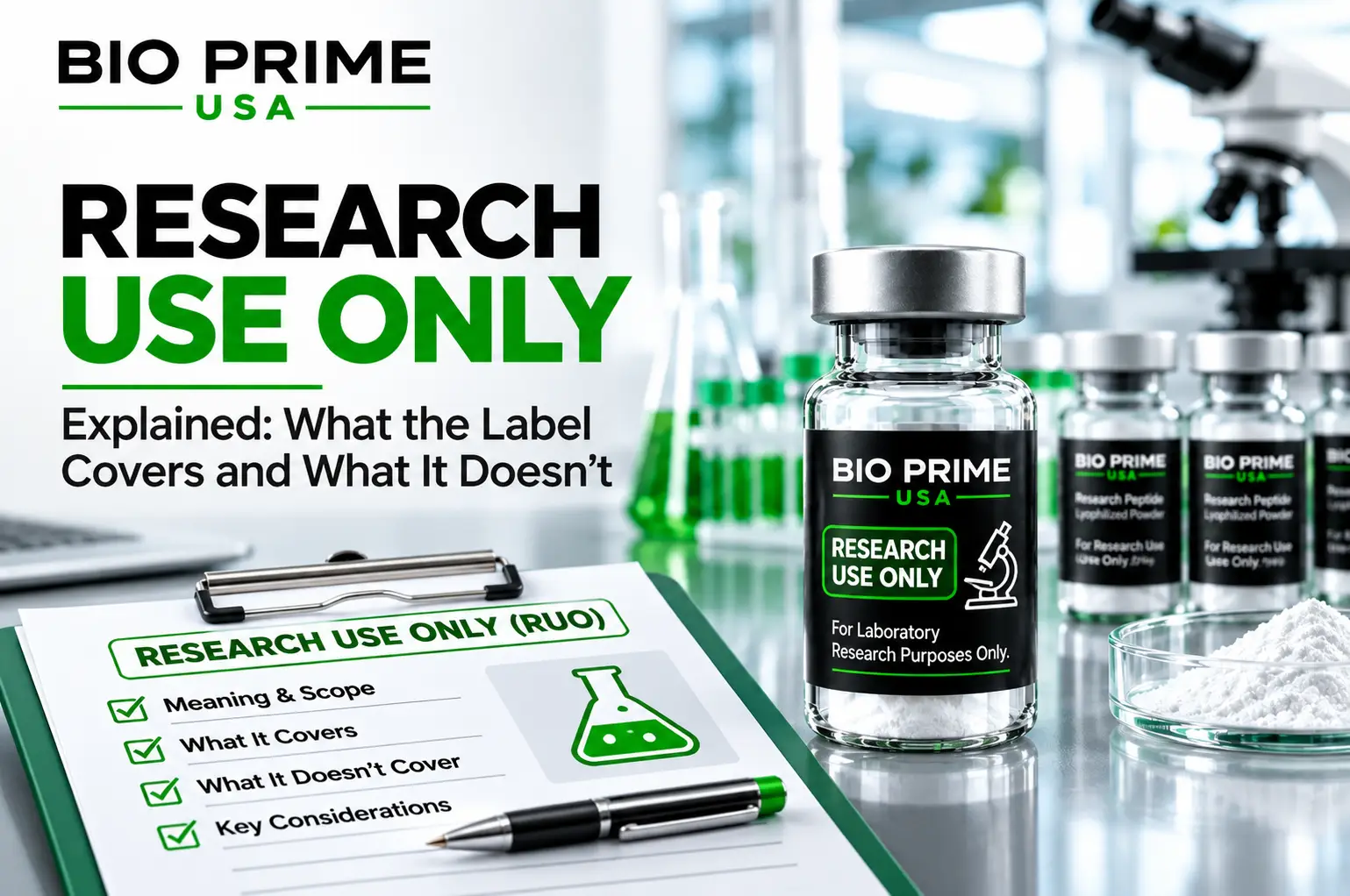
Research use only labelling states the intended laboratory use of a material. It does not indicate approval for any other purpose.
What Does Research Use Only Actually Mean?
The phrase “research use only” appears on almost every laboratory reagent catalogue, yet it is one of the most misunderstood labels in research sourcing. Many people read it as a quality certification or as a sign that a product has been approved for some purpose. It is neither. Research use only (RUO) is a statement of intended use. It tells a laboratory what a material is meant for and what it is not meant for, and it places responsibility on the buyer to use the material accordingly. This guide explains what the label covers, what it does not cover, and how research teams should interpret it when evaluating materials for an institutional programme.
Quick answer: Research use only means a material is intended for laboratory investigation. It does not mean the material has been tested for safety or effectiveness in people, and it does not replace the documentation a researcher needs to verify quality.
What the Research Use Only Label Means
Research use only is a labelling category used for laboratory reagents, reference standards and analytical materials. It tells the buyer that the product is intended for investigation in a laboratory setting, such as assay development, analytical method work or in vitro studies. The label describes the purpose the supplier has assigned to the product.
In practice, the label sets the boundary of responsible use. A research team that receives an RUO material is expected to use it only for the laboratory purposes the supplier describes and to keep it within the controlled environment the institution has approved.
What the Label Does Not Mean
The most common misreading is that RUO indicates quality, safety or approval. It does not. A research use only label is not a certification issued by a regulator, and it does not show that a product has passed clinical, safety or efficacy review. It also does not mean that a product is suitable for any purpose outside the laboratory.
- It does not mean the material is an approved medicine, supplement or treatment.
- It does not mean the material has been evaluated for safety or effectiveness in people or animals.
- It does not mean the material is free of legal requirements.
- It does not confirm identity, purity or batch quality on its own.
Intended Use Versus Actual Use
A label states intended use, but it cannot control what happens after a product leaves the supplier. That gap is why institutions rely on internal controls. A supplier can say a product is for laboratory research, while a buyer may still use it in ways that fall outside the institution’s approved protocols. The responsibility for keeping use within scope rests with the research organisation, the principal investigator and the people handling the material.
Clear scope is therefore part of good practice. Researchers should be able to state the experimental purpose, the approved protocol, the storage conditions and the disposal route for any RUO material in their programme.
The Institution’s Role in Interpreting RUO
Most universities, research centres and analytical laboratories have internal procedures that govern how research materials are purchased, received, stored and used. These procedures turn an RUO label into an operational rule. They typically cover supplier approval, purchase records, traceability and sign-off before a material enters a project.
Because the label alone is not enough, an institution should check that the material and its intended use are allowed under the applicable national and local rules, and that the material has been approved internally before it is accepted into a research programme.
Why Documentation Matters More Than the Label
An RUO label says what a product is for. Documentation shows what the product actually is. A batch-specific Certificate of Analysis, a clearly named analytical method, mass spectrometry data consistent with the expected molecular mass and traceable batch records give a research team the evidence it needs to judge quality.
Researchers who rely on the label alone cannot tell whether two RUO products are equivalent. Researchers who review documentation can compare them on identity, purity method and lot records. The closing section below links to the full COA and test records.
Regulatory Context: Labels Are Not Legal Clearance
Regulatory status depends on what a material is, how it is used, where it is handled and which jurisdiction applies. The United States Food and Drug Administration (FDA) regulates medicines, medical devices and certain other products, and its rules do not treat an RUO label as a licence for any use. Institutions should independently confirm which rules apply rather than assuming that a label settles the question. The FDA website is a starting point for regulatory information.
Warning Signs That Misuse the RUO Label
Some sellers use the RUO label as cover for promotion or for claims that the label cannot support. Research teams should treat the following as reasons for closer review:
- Health, performance or therapeutic claims attached to a research material
- Dosing or personal-use instructions on a product page
- The RUO statement appearing only as small print, far from the product details
- No lot-specific documentation available on request
- Refusal to answer questions about intended use or documentation
Any of these signs suggests that the label is being used for marketing rather than as an accurate statement of intended use.
Frequently Asked Questions
1. What does research use only mean?
It means a material is intended for laboratory investigation. It states intended use and does not indicate approval, safety or effectiveness for any other purpose.
2. Does RUO mean a product is high quality?
No. The label does not measure quality. Quality is shown by batch-specific documentation such as a Certificate of Analysis, method details and identity data.
3. Is an RUO product approved for human use?
No. Research use only materials are not approved for human or veterinary administration, diagnosis, treatment or prevention of disease.
4. Who is responsible for keeping RUO materials within their intended use?
The research organisation and the people handling the material are responsible. The supplier’s label sets the intended use, but the institution enforces it through its own procedures.
5. Does an RUO label mean a product is legal to buy?
Not necessarily. A label does not settle legal status. Institutions should check the applicable national and local regulations before acquiring any material.
6. Can a research team use an RUO product for a different purpose?
Using a material outside its stated intended use or outside the approved protocol is not recommended. Any change of purpose should be reviewed and approved through the institution’s own process.
7. Why do institutions check suppliers if a product is labelled RUO?
Supplier checks confirm business details, documentation, traceability and compliance. The label does not replace those checks, so institutions keep records of each review.
8. What documentation should accompany an RUO material?
A batch-specific Certificate of Analysis, the analytical methods used, the identity and purity results, storage guidance and a clear intended-use statement are the minimum a research team should expect.
9. Is a research-grade product the same as a pharmaceutical-grade product?
No. Research-grade materials are made and labelled for laboratory use. Pharmaceutical products follow separate regulatory and manufacturing frameworks and are not interchangeable.
10. Where can I learn more about evaluating research materials?
See the related guide on peptides for research for background on quality, testing and sourcing considerations.
Conclusion
Research use only is a statement of intended use, not a mark of quality, safety or approval. Its meaning depends on how the institution interprets it, which is why purchasing procedures, scope control and batch-level documentation matter more than the label itself. Research teams that read the label as a boundary, and then verify the material through its records, are in the strongest position to produce reproducible work.
Research use only. Not for human or veterinary use.
Review the Documentation Before You Order
Read the intended-use statement and the batch records together.
Explore BioPrime USA’s testing records, browse the research-use-only shop, or assemble a kit for a planned study.