

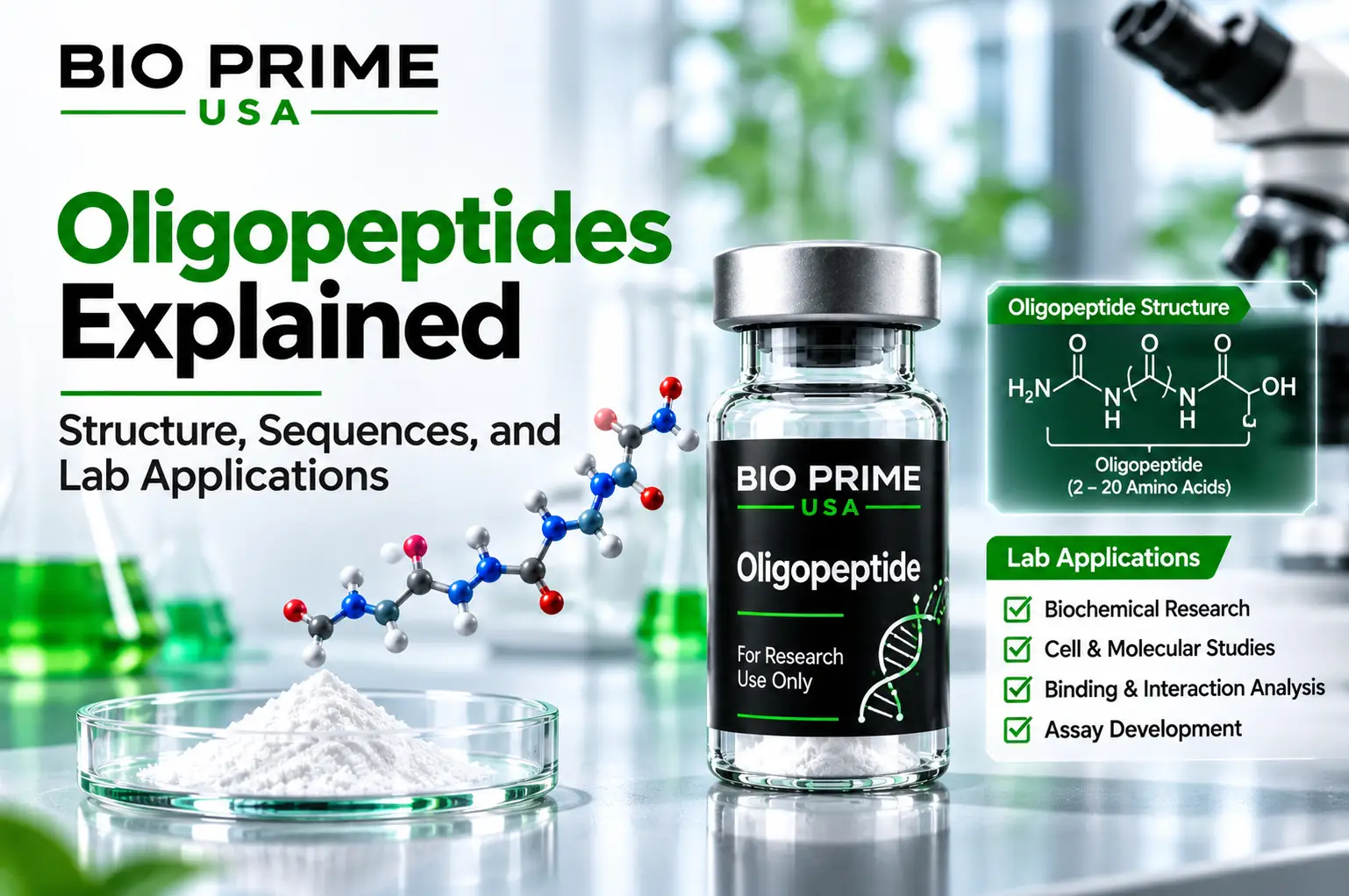
An oligopeptide is a short chain of amino acids joined by peptide bonds, read from the N-terminus to the C-terminus.
What Are Oligopeptides and Why Do They Matter in Research?
An oligopeptide is a short chain of amino acids linked by peptide bonds. They are typically made up of 2-20 amino acids. Within biochemistry, they are an important tool as they are shorter than proteins that are formed from long polypeptides and longer than individual amino acids. However, ‘oligopeptide’ can be a very vague term, and many people get confused about oligopeptides vs polypeptides. As these are short chains, many think they are easy to synthesize and verify. In this article we will go through what an oligopeptide is, the structure of oligopeptide, the amino acid sequence, how they are synthesized and verified and what they are used for in the lab.
Quick Answer
An oligopeptide is a short peptide containing around 2-20 amino acids linked together by peptide (amide) bonds. An oligopeptide is very similar to a polypeptide, but just shorter. They are defined by the sequence of amino acids within them and the sequence is always presented from the N-terminus to the C-terminus.
Key Facts
- Length of chain – typically between 2-20 amino acids (although this is just a convention)
- Linked by – peptide bonds (condensation reaction, removing one water molecule for each bond formed)
- Number of bonds – n-1 bonds for a chain of n amino acids
- Sequence – The sequence is always presented from the free amino group (N-terminus) to the free carboxyl group (C-terminus).
- Synthesized – Usually using solid phase peptide synthesis
- Verified – Using HPLC (for purity) and Mass Spectrometry (for identity)
What is an Oligopeptide?
An oligopeptide is a short polymer of amino acids. The prefix oligo means “few” in Greek. Most sources define oligopeptides as having between 2-20 amino acids, however, some textbooks will define them as having up to 10 amino acids and others up to 30 amino acids. As this is convention it is better to understand they are simply the shorter side of the peptide family.
Each amino acid in the chain is known as a residue. These are linked together via peptide bonds. Peptide bonds are covalent amide bonds formed between the carboxyl group of one amino acid and the amino group of another. This forms a condensation reaction and causes removal of one water molecule.
Naming
Peptides are often named based on how many amino acids (residues) they have. The prefixes give you a quick indication of the size.
| Name | Number of Residues | Number of Bonds |
|---|---|---|
| Dipeptide | 2 | 1 |
| Tripeptide | 3 | 2 |
| Tetrapeptide | 4 | 3 |
| Pentapeptide | 5 | 4 |
| Decapeptide | 10 | 9 |
A single amino acid is a monomer, whilst an oligopeptide is a short chain of amino acids. A polypeptide is a longer chain of amino acids. A protein is 1 or more polypeptide chains folded into a specific 3D shape. See Peptides for Research for an overview of the peptide family.
Oligopeptide Structure
The structure of an oligopeptide is dictated by 3 factors: the amino acids, the bonds between them and the two ends of the chain. To understand these 3 points will help you read almost any peptide formula.
Amino Acids & Peptide Bonds
All standard amino acids contain a central carbon. This is attached to an amino group, carboxyl group, hydrogen atom and side chain (R group). The side chains are what make each amino acid unique. When 2 amino acids link together the carboxyl carbon of one links to the nitrogen of another. This forms the peptide bond. This bond is planar and has a partial double bond meaning it does not rotate easily, giving rigidity to the backbone.
The side chains remain free and will extend out from the backbone. The size, charge and polarity of the side chains will affect how it behaves in solution, how soluble it is and how it will separate during analysis.
N-terminus & C-terminus
An oligopeptide has directionality. One end will have a free amino group and this is known as the N-terminus. The other end will have a free carboxyl group and this is known as the C-terminus. By convention sequences are always presented from the N-terminus. The two ends are not interchangeable and Gly-Ala will have different properties to Ala-Gly.
Primary Structure
The primary structure refers to the sequence of amino acids within a peptide. For short peptides this is usually the main structural feature as they rarely will fold into a stable structure. This is why short peptides are often used as simple and well defined models. Longer polypeptides can fold into secondary and tertiary structures.
Oligopeptide vs Polypeptide
The main difference between an oligopeptide and polypeptide is the length of the chain. They are short whilst polypeptides are longer chains usually over 20 residues. Proteins are polypeptides (or made up of polypeptides) folded into a specific functional shape.
| Feature | Oligopeptide | Polypeptide | Protein |
|---|---|---|---|
| Length | Typically 2-20 residues | Typically >20 residues | Often 50+ residues |
| Molecular Weight | Typically <2500Da | Typically several thousand Da | Typically >5000Da |
| Folded structure | Usually little folding | May partially fold | Defined 3D structure |
| Typically synthesized | Using solid phase peptide synthesis | More difficult to synthesize using solid phase peptide synthesis | Usually recombinantly expressed |
These are all general guidelines. Different textbooks and journals will have slightly different conventions for what defines an oligopeptide, so it is best to check how the author has defined it in the paper or certificate of analysis.
Understanding Oligopeptide Sequences
An oligopeptide sequence shows the amino acids present in the oligopeptide. The order of the amino acids will affect the distribution of mass, charge, polarity and behaviour during analysis.
Reading an Oligopeptide Amino Acid Sequence
To read an oligopeptide sequence you need to start from the left (N-terminus) and work your way along to the right (C-terminus). Each name or letter shows one residue. For example, Gly-Ala-Ser would mean there are 3 residues in the chain; glycine at the N-terminus, alanine in the middle and serine at the C-terminus.
The molecular weight can be roughly calculated by adding the molecular weights of the free amino acids and subtracting one water molecule (~18Da) for each peptide bond. So for Gly-Ala-Ser there are 3 free amino acids totalling ~269Da. Subtract 2 water molecules to give a molecular weight of ~233Da. This simple calculation is what mass spectrometry is used for.
One Letter & Three Letter Code
There are two common ways of presenting amino acids. The three letter code is easier to read whilst the one letter code is more concise and used for longer sequences and in databases. The IUPAC and IUBMB have standardised the codes.
| Amino Acid | 3 Letters | 1 Letter |
|---|---|---|
| Glycine | Gly | G |
| Alanine | Ala | A |
| Serine | Ser | S |
| Leucine | Leu | L |
| Lysine | Lys | K |
The example would be presented as Gly-Ala-Ser (3 letters) or GAS (1 letter). Always ensure the document you are reading states which code it is using and that the N-terminus is on the left hand side.
Oligopeptide Synthesis in the Lab
Short peptides are most commonly synthesized chemically. The most common method used is solid phase peptide synthesis, developed by R. Bruce Merrifield in the 1960s and awarded a Nobel Prize in Chemistry in 1984.
Solid Phase Peptide Synthesis (SPPS)
The first amino acid is attached to an insoluble resin via its C-terminus. The chain is then built up one residue at a time from the N-terminus. This involves removing a temporary protecting group, adding the next protected amino acid and washing away any excess reagents. As the peptide chain is attached to the resin it is easy to purify between steps by simply filtering and washing. Once the sequence is complete the peptide chain is cleaved off the resin and the protecting groups are removed.
The most common protection schemes are Fmoc/tBu and Boc/Bzl. Fmoc chemistry is more widely used nowadays due to the milder conditions.
Why is it difficult to make certain sequences?
Each coupling step is not 100% efficient. This means you will lose some efficiency at each step. For example if each step was 99% efficient the overall theoretical yield for a 20 amino acid chain would be ~82%. The longer the chain becomes the quicker this will drop. Some sequences will also be more difficult to make. For example if there are a lot of hydrophobic residues they may cause aggregation on the resin. Or if there are amino acids that are more prone to side reactions. This means short chains are easy to make but long polypeptides become challenging. It is therefore important to verify each batch analytically.
Verifying Purity and Identity of Oligopeptide
During synthesis some by-products will be formed. These could include truncation or deletion sequences. There are 2 separate things to verify. Firstly that the main product is the correct molecule. Secondly how pure the sample is. Both purity and identity are measured using different techniques.
Purity (HPLC)
Reversed phase high performance liquid chromatography (RP-HPLC) will be used to separate your target peptide from any related impurities. Peptide bonds strongly absorb UV light at around 214-220nm meaning it will be detected in this range. Purity would usually be given as a percentage of the total peak area. This will depend on the method used.
Identity (Mass Spectrometry)
Mass spectrometry will give you the molecular weight of your product. The most common methods for peptides are electrospray ionisation (ESI) and matrix assisted laser desorption/ionisation (MALDI). The molecular weight will be compared to the theoretical molecular weight. If they match it will confirm it is the correct molecule. If they don’t match it can indicate a missing residue, incomplete deprotection or modification.
Certificate of Analysis
A Certificate of Analysis (COA) will show the results for that batch. A useful COA will tell you what sequence it is, what lot number it is, what method was used for HPLC, what purity it has, what molecular weight it has and what the theoretical molecular weight is. It will also tell you when it was tested. This will help your research team decide if the batch is suitable for your experiment. See COA Test Results for how BioPrime USA present this information.
Useful information to look for in a COA:
- Sequence is stated with the N-terminus first
- Batch/lot number matches the vial
- HPLC purity with method
- Molecular weight
- Date tested & storage recommendation
Use in the Lab
As these peptides are short, well defined and chemically accessible they can be used as tools in many areas of lab science. They can be used for:
- Enzyme/Protease Assays – Short sequences can act as substrates to assess enzyme activity and specificity.
- Epitope Mapping – Overlapping short peptides can help identify the region of a protein recognized by an antibody.
- Standards – Well defined oligopeptides can be used to help calibrate and test chromatography and mass spectrometry methods.
- Binding Studies – Short sequences can be used to study how a region of a protein interacts with a partner in vitro.
- Structure Activity – Swapping single residues can help identify how each amino acid contributes to a property.
- Method development – Oligopeptides can be used as simple and reproducible models to test synthesis, purification and detection methods.
It is always best practice to have a clear aim for your experiment, follow an approved method, store and handle correctly and have batch specific information. Any materials sold for lab use should only be used for lab research. Please consider any relevant laws and institutional requirements. If you are looking to carry out a study you can search our research only shop in Shop All or create your own kit using Build Your Own Kit after reading through the documentation.
FAQ
What is an oligopeptide?
An oligopeptide is a short chain of approximately 2-20 amino acids linked together by peptide bonds. They are shorter than polypeptides and are defined by the sequence of amino acids within them. The sequence is always presented from the N-terminus to the C-terminus.
How many amino acids are in an oligopeptide?
Most will define an oligopeptide as having approximately 2-20 amino acids. However, the exact number will vary depending on the source. Some will use 10 and some will use 30. Be sure to check how the author has defined oligopeptide in the paper/document.
What is the difference between an oligopeptide and polypeptide?
The main difference between an oligopeptide and a polypeptide is the length. Oligopeptides are short (typically up to 20 residues) and polypeptides are longer. Proteins are polypeptides (or made up of polypeptides) that have folded into a defined 3D structure.
How are peptide bonds formed in oligopeptides?
Peptide bonds are formed when the carboxyl group of one amino acid reacts with the amino group of another. This forms a condensation reaction resulting in removal of one water molecule. This results in a covalent amide bond.
How do I read an oligopeptide amino acid sequence?
Read from left to right. The N-terminus will always be on the left. Each name or letter represents one residue. For example Gly-Ala-Ser will have glycine at the N-terminus, alanine in the middle and serine at the C-terminus.
What is the difference between one letter and three letter amino acid codes?
Both are standardised shorthand for amino acids. The 3 letter code (e.g. Gly) are easier to read whilst the 1 letter code (e.g. G) are more concise and used for longer sequences and databases.
How are oligopeptides synthesized in the lab?
Most are synthesized using solid phase peptide synthesis. The first amino acid is attached to a resin. The chain is then built up one residue at a time. At the end the peptide is cleaved off the resin and deprotected.
How is oligopeptide purity verified?
Purity is usually measured using reversed phase HPLC. This will give you the percentage of the main peak. Identity can be confirmed using mass spectrometry. Both should be present on the Certificate of Analysis for that batch.
Why does the order of amino acids matter?
The sequence defines the molecule. Gly-Ala and Ala-Gly will have the same residues but are different compounds. They will have different chemical properties and behaviour during analysis as the N-terminus and C-terminus cannot be swapped.
Are oligopeptides only used in research?
No. Short peptides can be found naturally and are used in many areas of science. This guide has focused on lab research. Any materials sold for research should only be used for research purposes.
Summary
An oligopeptide is a short chain of amino acids. They are defined by the sequence of amino acids within them (always from the N-terminus to the C-terminus). They are usually synthesized using solid phase synthesis and verified using HPLC for purity and mass spectrometry for identity. Understanding the structure, sequence and information on the batch will help your research team select the right materials and achieve reproducible results.
For research and educational purposes only.
Read the Documentation
Sequence, method & batch information.
See testing records from BioPrime USA, search our research only shop or create your own kit for your study.